ISpring Water Systems Unveils the BRO900: A Professional Seawater Desalination System Designed to Transform Marine Water Security


For seasoned mariners, commercial crews, and coastal residents navigating the world’s oceans, a single immutable truth remains: fresh water is as precious as gold. Whether a vessel is anchored in a secluded cove, cruising between international marinas, or embarking on extended off-grid voyages, maintaining a reliable, high-capacity source of drinking water is critical to survival, comfort, and operational success. Historically, offshore sailors have faced severe constraints, forced to ration limited tank capacities or make frequent, time-consuming port calls solely to replenish freshwater supplies.
To systematically address this enduring maritime challenge, iSpring Water Systems—an established industry leader in advanced residential and commercial water filtration—has officially announced the expansion of its engineering expertise into the marine sector. The crown jewel of this strategic expansion is the introduction of the BRO900, a professional-grade seawater desalination system engineered specifically for boats, yachts, and coastal living applications. By seamlessly combining heavy-duty purification technology with a compact, practical layout, the BRO900 transforms untreated ocean water into clean, great-tasting, potable water for crews, passengers, and everyday onboard utility use.
The launch of the BRO900 marks a significant corporate milestone for iSpring Water Systems. As the newest flagship addition to the company’s diverse product ecosystem, the system embodies a long-standing commitment to engineering innovative, highly reliable water treatment solutions. By bringing institutional-grade filtration standards to the marine environment, iSpring aims to empower navigators to enjoy cleaner, safer hydration wherever their maritime journeys take them.
The Engineering Architecture of the BRO900: Advanced 5-Stage Filtration
At the core of the iSpring BRO900’s superior performance is a rigorous, multi-tiered purification architecture. Seawater is notoriously difficult to treat due to its high concentration of dissolved solids, suspended organic matter, microscopic pathogens, and industrial pollutants. To overcome these complexities, the BRO900 deploys an advanced five-stage filtration sequence designed to systematically strip contaminants at every level.
The filtration journey begins with a heavy-duty stainless-steel mesh filter, which captures large debris, marine algae, and macroscopic particulates before they can enter the core machinery. Following this initial physical barrier, the water passes through a 20-micron polypropylene (PP) filter, which traps intermediate-sized sediment and rust particles. The third stage utilizes a finer 5-micron PP filter, ensuring that microscopic suspended solids are entirely eradicated prior to high-pressure processing.
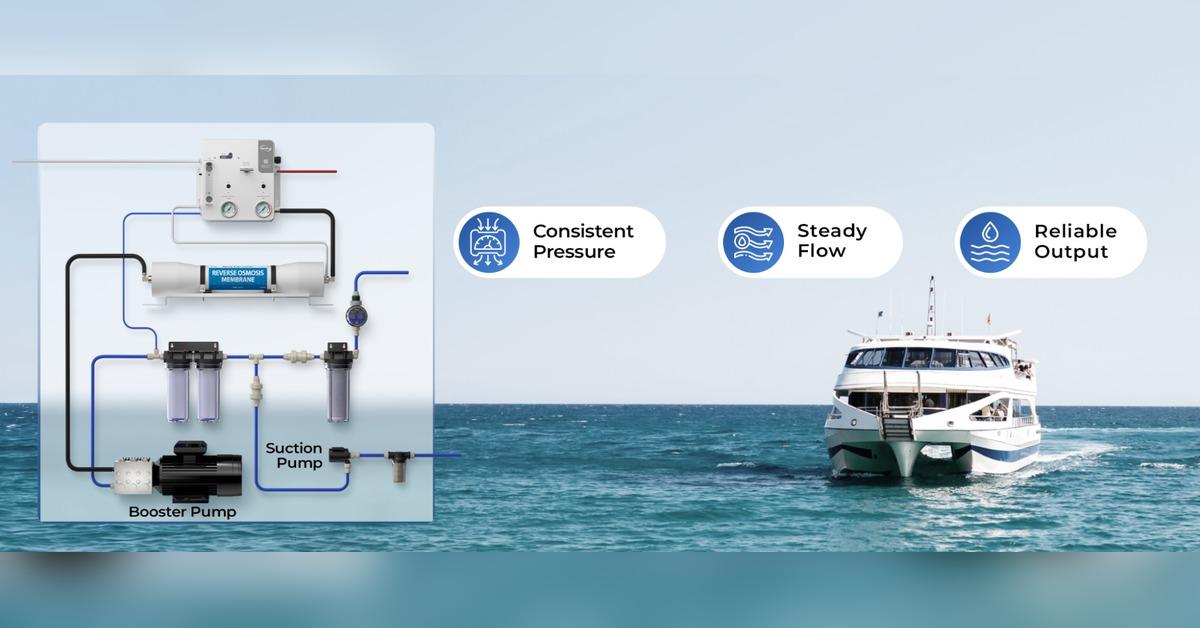
Once pre-filtered, the water encounters the cornerstone of the system: a specialized industrial-grade reverse osmosis (RO) membrane. Operating under extreme pressure, this membrane serves as an impenetrable barrier against up to 99% of dissolved salts, persistent per- and polyfluoroalkyl substances (PFAS), heavy metals, and other chemical contaminants. Finally, the purified water is routed through a built-in ultraviolet (UV) LED module housed safely within the master control box. This final germicidal step neutralizes any residual bacteria, viruses, and microorganisms, guaranteeing that the output water meets the highest standards of microbiological safety.
Overcoming Marine Dynamics: Dual-Pump Engineering and Stability

Keeping a consistent volume of seawater flowing into an onboard desalination system is a notoriously difficult engineering hurdle. When a vessel is underway, dynamic forces such as fluctuating ship speeds, wave action, hull rolling, and pitching cause continuous draft variations. These environmental shifts frequently disrupt traditional intake pumps, leading to erratic system pressures and frequent operational shutdowns.
To neutralize these maritime variables, iSpring engineers equipped the BRO900 with a sophisticated dual-pump configuration consisting of a dedicated suction pump and a high-pressure booster pump. The primary suction pump is engineered to draw a steady, uninterrupted volume of seawater into the system, ensuring an optimal baseline flow even when the vessel is navigating rough seas or operating at high speeds.
Once the intake flow is stabilized, the high-pressure booster pump activates, elevating the internal water pressure to a staggering 600 to 900 psi (pounds per square inch). This immense hydraulic force is necessary to overcome the natural osmotic pressure of seawater, successfully driving the water molecules through the specialized RO membrane. Working in tandem, these two pumps guarantee dependable, continuous water production across a wide spectrum of navigational conditions.
Smart Control Interface and Operational Precision
Beyond its formidable purification capabilities, the iSpring BRO900 is engineered to maximize user-friendliness and operational transparency. Managing a high-pressure marine desalination system requires precise monitoring of pressure differentials, water purity, and flow rates. To streamline this process, the BRO900 features an intuitive, centralized smart control box panel.
The control interface provides operators with real-time data feeds, including a total dissolved solids (TDS) digital readout, an RO flow meter, and dual pressure gauges that continuously display intake and RO operating pressures. This telemetry allows crew members to immediately assess system health and filtration efficiency at a glance. Furthermore, the unit is outfitted with dedicated suction and RO pressure regulators, enabling operators to make precise, manual pressure adjustments tailored precisely to varying sea temperatures, ambient salinities, and regional water conditions. Independent switches for the suction and booster pumps provide an additional layer of operational flexibility during startup, maintenance, and shutdown procedures.
Automated Maintenance: RO Membrane Protection and Flushing Protocols
In the harsh chemical environment of marine desalination, equipment longevity is heavily dependent on proactive maintenance. Salt crystals and mineral deposits naturally accumulate on the surface of reverse osmosis membranes over time. If left unmanaged, this accumulation leads to severe membrane scaling and biological fouling, which rapidly diminishes filtration efficiency and prematurely ruins expensive system components.
To eliminate the burdensome guesswork associated with manual membrane maintenance, the BRO900 features an advanced, automated flushing system. This smart utility periodically rinses the RO membrane with a designated volume of filtered water, effectively purging residual brine, preventing salt crystallization, and arresting biofouling before it can take hold.

Owners and operators can easily program the automated flusher to execute maintenance cycles on a custom schedule—such as once a week—while fine-tuning the exact duration of the flush cycle to match their specific operating environment. For maximum versatility, the system also supports manual flushing commands, allowing operators to execute a protective rinse instantly whenever the system is prepared for long-term storage or decommissioned at port.
Robust Construction Tailored for Harsh Marine Climates
The marine environment is exceptionally punishing on mechanical and electrical infrastructure. The combination of high ambient salinity, airborne salt spray, persistent humidity, and severe thermal fluctuations creates a corrosive atmosphere that degrades standard metallic components at an accelerated rate compared to land-based systems.
To ensure long-term reliability in these unforgiving settings, the iSpring BRO900 is constructed almost entirely from high-grade, corrosion-resistant materials capable of withstanding prolonged exposure to saltwater. Structural brackets, internal plumbing connectors, and exterior chassis elements are engineered to resist pitting and galvanic corrosion.
Moreover, recognizing that ocean-going vessels frequently encounter violent sea states, violent pitching, and constant structural vibrations, iSpring has designed the BRO900 with ruggedized internal components. Heavy-duty mounting points and shock-absorbing hardware ensure that the unit remains securely anchored and fully functional despite the relentless mechanical stress of offshore navigation.
Economic and Operational Implications: Extended Cruising Ranges
The introduction of the BRO900 arrives at a time when the broader marine industry is placing a heightened emphasis on operational efficiency, fuel economy, and extended self-sufficiency. Historically, embarking on long-range offshore expeditions required vessels to allocate massive amounts of internal storage space to bulky freshwater holding tanks.
Carrying hundreds—or even thousands—of gallons of pre-stored municipal water carries a profound economic penalty. Water weighs approximately 8.34 pounds per gallon; thus, carrying large freshwater reserves adds immense deadweight to a vessel. This excess weight directly impairs fuel efficiency, drives up operational costs, and severely restricts a vessel’s overall cruising range.
By delivering up to 900 gallons of high-purity, refreshing water daily at a standard operating pressure of 800 psi, the iSpring BRO900 fundamentally alters this equation. The system’s compact, modular footprint allows boat builders and retrofitters to reclaim valuable hull space previously wasted on oversized storage tanks, dedicating that volume instead to essential wiring, safety gear, and provisions. Most importantly, by generating potable water on demand, the BRO900 eliminates the need to carry massive freshwater reserves, empowering vessels to venture significantly farther offshore with complete confidence.
Improving Daily Onboard Quality of Life
Beyond structural efficiency, the availability of abundant fresh water directly transforms the day-to-day quality of life for everyone on board. On extended voyages, water rationing is a frequent source of psychological stress and physical discomfort, limiting basic hygiene, laundry, and culinary activities.
With the BRO900 operating reliably in the background, daily tasks such as cooking, beverage preparation, dishwashing, laundry, and personal showers become effortless. By consistently eliminating up to 99% of dissolved impurities and pathogens, the system ensures that every cup of coffee, every cooked meal, and every glass of drinking water is crisp, clean, and entirely safe. This reliability removes the constant anxiety of running dry in remote waters, providing unparalleled peace of mind for captains and passengers alike.
Launch Timeline, Availability, and Special Promotional Offers
The iSpring BRO900 is scheduled for its official global market launch on October 20, 2026. This release represents a calculated, strategic expansion for iSpring Water Systems as the company transitions its proven filtration pedigree into the commercial and recreational marine sectors.
To commemorate the rollout and encourage early adoption among boat owners, yacht captains, and marine outfitters, iSpring has announced a limited-time promotional campaign. Beginning on the official launch date of October 20 and running through November 20, 2026, the company will offer a substantial $1,000 introductory discount on the purchase price of the BRO900 system. Industry analysts note that this aggressive promotional pricing strategy is likely to accelerate initial market penetration, positioning iSpring as a formidable competitor in the specialized marine desalination market.
As coastal populations grow and offshore recreation continues to expand, the demand for reliable, autonomous water infrastructure has never been higher. With the launch of the BRO900, iSpring Water Systems has demonstrated its capacity to engineer sophisticated solutions that meet the rigorous demands of the open ocean, setting a new benchmark for marine water security and operational independence.