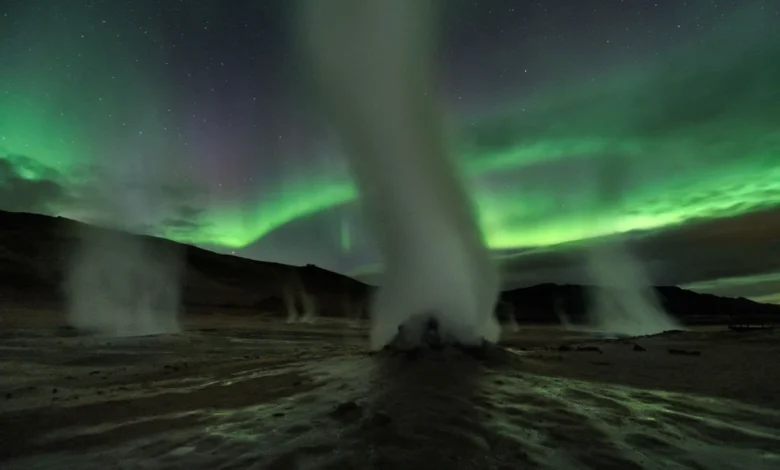
Ghostly pillars of white steam rising from subterranean vents beneath an ethereal curtain of green light create an otherworldly tableau that might easily be mistaken for a scene from a science fiction film. Captured at Hverir, a hyper-active geothermal field nestled within the volcanic landscape of northeastern Iceland, this striking photograph was selected by NASA as its Astronomy Picture of the Day for October 31, 2026. Credited to astrophotographer Stéphane Vetter of Nuits sacrées, the image merges terrestrial vulcanism with celestial mechanics, showcasing the raw and dynamic forces that shape our planet while offering a timely nod to the Halloween season.
The composition highlights a fascinating intersection of geology and space weather. Against a backdrop of a star-speckled night sky, volcanic fumaroles—vents through which volcanic gases and steam escape—spew heated plumes into the cold night air. Intermingling with these terrestrial vapors are vibrant, undulating ribbons of green aurora borealis. The result is a hauntingly beautiful portrait of Earth, reminding observers that our home planet can host phenomena as alien and mysterious as any distant exoplanet in the cosmos.
Main Facts and Scientific Mechanics
The stunning visual juxtaposition captured at Hverir is the direct consequence of two distinct yet interacting physical systems: Earth’s internal geothermal engine and the external influence of solar weather.
On the ground, the Hverir geothermal area sits adjacent to the Krafla volcanic system in Iceland’s Northern Volcanic Zone. This region is characterized by intense tectonic and magmatic activity, driven by the drifting apart of the North American and Eurasian tectonic plates along the Mid-Atlantic Ridge. Superheated water beneath the Earth’s crust flashes into steam, forcing its way to the surface through mud pots, fumaroles, and fissures, creating a landscape rich in sulfurous deposits and perpetual, ghostly vapor clouds.
High above this steaming terrain, the atmosphere is painted with light by processes originating 93 million miles away at the Sun. The vibrant green curtains of the aurora borealis are triggered by solar activity. When the Sun ejects streams of charged particles—electrons and protons—into the solar wind, these particles occasionally interact with Earth’s protective magnetic field, or magnetosphere. During periods of heightened solar activity, these energetic particles become trapped and are funneled toward Earth’s polar regions along geomagnetic field lines.
As these charged particles cascade downward, they collide with gas molecules in Earth’s upper atmosphere, primarily oxygen and nitrogen, at altitudes ranging from 60 to over 200 miles. The collisions excite the gas molecules, causing them to temporarily absorb energy and subsequently release it in the form of photons—light. The characteristic green hue that dominates the Hverir photograph is produced when energetic electrons collide with oxygen atoms at altitudes of roughly 60 to 150 miles.
Chronology and Solar Cycle Context
The appearance of intense auroral displays over Iceland in late 2026 is part of a broader, predictable temporal cycle tied to the Sun’s magnetic activity. The Sun undergoes an approximately 11-year cycle known as the solar cycle, characterized by a periodic rise and fall in the number of sunspots, solar flares, and coronal mass ejections (CMEs).
During the solar minimum, the Sun is relatively quiet. However, as the cycle progresses toward the solar maximum, magnetic fields twist and tangle, leading to a dramatic increase in energetic space weather events. The peak of the current solar cycle, Solar Cycle 25, has generated substantial scientific interest and public awe worldwide, producing frequent and powerful geomagnetic storms that have pushed auroral displays far lower in latitude than is typical.
Although the solar maximum has officially peaked, solar activity does not drop off precipitously overnight. Instead, the Sun descends gradually from its peak into the declining phase of the cycle. During this transitional period, coronal holes—regions of open magnetic field lines in the Sun’s outer atmosphere—frequently open up, releasing high-speed streams of solar wind that repeatedly buffet Earth’s magnetosphere. It was one such sustained influx of solar wind that triggered the geomagnetic storm conditions required to light up the skies over Hverir just as the world celebrated Halloween.

Supporting Data and Observational Logistics
Capturing the fleeting interplay between a volcanic geothermal vent and a dynamic auroral arc requires a precise combination of timing, equipment, and environmental awareness. Astrophotographer Stéphane Vetter utilized specialized low-light camera equipment capable of exposing faint celestial details without introducing excessive digital noise, while balancing shutter speeds to keep the rapidly shifting auroral curtains from blurring into a uniform green wash.
Geothermal fields like Hverir present unique operational challenges for photographers and scientists alike. The ambient air is heavily saturated with sulfur dioxide, hydrogen sulfide, and moisture, which can rapidly corrode sensitive electronic equipment and coat camera lenses in mineral-laden condensation. Furthermore, the ground itself can be dangerously unstable, with boiling mud pots and scalding steam vents hidden beneath thin crusts.
Despite these hazards, high-latitude volcanic sites remain premier locations for night-sky photography. Iceland’s position directly beneath the auroral oval—a band encircling the geomagnetic pole where aurorae are most frequent—combined with its minimal light pollution in rural areas, makes it an ideal natural laboratory for observing space-Earth interactions.
Official Responses and Educational Outreach
The inclusion of the Hverir photograph as NASA’s Astronomy Picture of the Day (APOD) highlights the space agency’s ongoing commitment to public science education and planetary literacy. Managed by astrophysicists Jerry Bonnell, Cecilia Chirenti, and Robert Nemiroff, alongside editor Keighley Rockcliffe, in cooperation with NASA’s Goddard Space Flight Center and Michigan Technological University, APOD has served as a daily window into the universe since 1995.
In the official accompanying commentary, NASA science communicators leaned into the seasonal theme, drawing parallels between the eerie visual characteristics of the Icelandic landscape and traditional Halloween imagery. By framing a rigorous scientific explanation within a culturally resonant context, the platform aims to engage broader audiences who might not otherwise seek out information regarding magnetospheric physics or vulcanology.
"What spooky planet is this?" the APOD editors remarked in their statement, answering their own query with a reminder of Earth’s unique place in the solar system. By explicitly linking terrestrial phenomena—such as volcanic steam and atmospheric optics—to interplanetary mechanics, NASA continues to emphasize that Earth is an active celestial body subject to the same cosmic forces that govern distant worlds.
Broader Impact and Implications
The scientific evaluation of events like the Hverir auroral display extends far beyond aesthetic appreciation. Understanding the mechanisms that drive geomagnetic storms and their interaction with Earth’s atmosphere is a critical component of modern space weather forecasting.
As human civilization becomes increasingly dependent on satellite constellations, global positioning systems, power grids, and high-frequency radio communications, understanding the vulnerabilities posed by solar activity is paramount. Energetic particles and fluctuating geomagnetic fields can induce electrical currents in long power lines, disrupt satellite electronics, and degrade GPS accuracy. Monitoring auroral intensity and the solar wind streams that generate them provides essential early warning data for operators of critical infrastructure.
Moreover, studying the auroral and volcanic processes on Earth offers valuable comparative models for planetary scientists studying other worlds within our solar system and beyond. Volcanism is known to exist or to have existed on Venus, Mars, and Jupiter’s moon Io, while auroral displays have been documented by spacecraft orbiting the gas giants Jupiter and Saturn. By examining how these forces manifest on a living, inhabited world, researchers gain critical insights into planetary evolution and the complex feedback loops that maintain habitable environments across the cosmos.