NASA’s ESCAPADE Mission Captures Stunning Earth-Moon Crescent Images in Visible and Thermal Infrared, Validating Instruments Ahead of Mars Journey

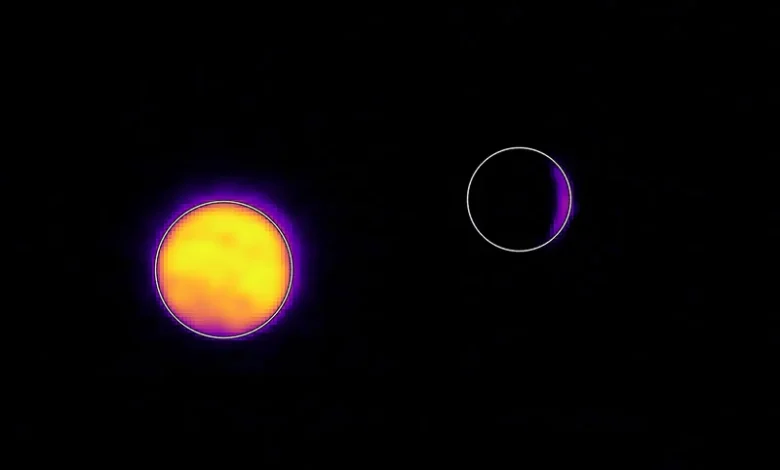
In a pivotal moment for deep-space instrument validation, one of NASA’s two Mars-bound ESCAPADE (Escape and Plasma Acceleration and Dynamics Explorers) spacecraft successfully captured striking images of Earth and the Moon on July 3, 2024. These unprecedented views, taken in both visible and thermal infrared light, not only offer a unique perspective of our home planet and its celestial companion but also serve as a crucial calibration check for the mission’s advanced cameras before their ultimate scientific endeavors at Mars. At the time of capture, the spacecraft was positioned approximately 363,250 miles (584,600 kilometers) from Earth and 115,600 miles (186,100 kilometers) from the Moon, a proximity that made the Moon appear notably large in the frames.
A Dual Perspective: Unveiling Earth and Moon in Light and Heat
The images provide a fascinating contrast between how Earth and the Moon appear in different wavelengths. The visible light image, captured when the Sun only partly illuminated both celestial bodies, depicted them as slender crescents. In this perspective, only about 8% of each face was sunlit, showcasing the delicate sliver of illumination against the vast darkness of space. This visual testament to their phase cycle from the distant vantage point of the ESCAPADE spacecraft offered a familiar yet profoundly alien view of our cosmic neighborhood.
However, it was the thermal infrared image that revealed a more profound scientific insight, particularly regarding Earth. In this spectral band, the shadowed hemisphere of Earth glowed distinctly, illuminated not by direct sunlight but by its own intrinsic heat. This luminescence emanated from both the planet’s atmosphere and its surface, registering temperatures between minus 10 to minus 44 degrees Fahrenheit (250 to 280 kelvins). This phenomenon underscores Earth’s robust thermal regulation, largely attributed to its substantial atmosphere and vast oceans, which act as insulating blankets, trapping and redistributing heat. The dynamic processes within Earth’s atmosphere, including convection and radiation, contribute significantly to this thermal signature, allowing even the planet’s unlit side to radiate detectable warmth into space. This starkly contrasts with the Moon. Devoid of insulating oceans and a significant atmosphere, the Moon’s far side, also cloaked in shadow, registered a much colder temperature of minus 280 degrees Fahrenheit (100 kelvins). This extreme temperature differential highlights the critical role of planetary atmospheres and hydrospheres in maintaining thermal equilibrium and, by extension, supporting habitable conditions.
The Eyes of ESCAPADE: The Visible and Infrared Observation System (VIOS)
The sophisticated imagery was made possible by ESCAPADE’s Visible and Infrared Observation System (VIOS) cameras, instruments developed and provided by Northern Arizona University in Flagstaff. These cameras are not merely for capturing "road trip photo album snaps," as highlighted by mission scientists; they are cutting-edge tools designed for rigorous scientific investigation. For the upcoming Martian phase of the mission, VIOS will play a critical role in two primary scientific pursuits: detecting visible Martian aurora and investigating the thermal properties of the Martian surface and atmosphere.
The ability to capture both visible and thermal infrared data is paramount for understanding planetary environments. Visible light reveals surface features, cloud patterns, and the direct reflection of solar radiation, while thermal infrared allows scientists to probe temperatures, atmospheric composition, and energy budgets regardless of solar illumination. This dual capability is particularly valuable for Mars, where significant temperature variations exist between day and night, and across different latitudes and altitudes.
A Critical Calibration Check: Ensuring Scientific Accuracy
The successful imaging of Earth and the Moon serves as a vital calibration check for ESCAPADE’s cameras. Rob Lillis, the mission’s principal investigator at the University of California, Berkeley, emphasized this point, stating, "We are thrilled that ESCAPADE was able to accommodate these excellent space-qualified cameras which will search for visible Martian aurora and investigate thermal properties of the Martian surface and atmosphere. Since Earth and the Moon are well-known targets, imaging them provides an important calibration check for ESCAPADE’s cameras."
Calibration in space missions is a meticulous and essential process. It involves validating that instruments are performing as expected in the harsh environment of space and that their readings are accurate and reliable. By imaging Earth and the Moon, whose physical characteristics, thermal profiles, and orbital parameters are extensively studied and well-understood, scientists can compare the data captured by ESCAPADE’s VIOS cameras against established benchmarks. This comparison allows for precise adjustments and verification of the instruments’ sensitivity, spectral response, and overall performance. Such a thorough calibration ensures that when ESCAPADE arrives at Mars, the novel data it collects will be of the highest scientific integrity, minimizing uncertainties and maximizing the impact of its discoveries. This step is particularly crucial for missions venturing into less-explored environments where direct ground truth is limited, making pre-flight and in-flight calibration against known targets indispensable.
The ESCAPADE Mission: Unraveling Mars’s Atmospheric Fate
The ESCAPADE mission, formally known as the Escape and Plasma Acceleration and Dynamics Explorers, is a groundbreaking endeavor funded by NASA’s Heliophysics Division and forms part of the agency’s Small Innovative Missions for Planetary Exploration (SIMP-X) program. Led by the UC Berkeley’s Space Sciences Laboratory, the mission involves a consortium of key partners including Rocket Lab, NASA’s Goddard Space Flight Center, Embry-Riddle Aeronautical University, Advanced Space, and Blue Origin.
The twin ESCAPADE spacecraft, ingeniously built by Rocket Lab, represent a new paradigm in cost-effective, high-impact planetary science. They are currently positioned in a "loiter" orbit around Lagrange point 2 (L2), a gravitationally stable location in space approximately a million miles (1.5 million kilometers) from Earth. Lagrange points are specific locations where the gravitational forces of two large bodies (in this case, the Sun and Earth) balance out, allowing a small object to maintain a stable position relative to them with minimal fuel expenditure. L2 is particularly advantageous for space telescopes and missions like ESCAPADE, as it offers an unobstructed view of deep space away from Earth’s interference, serving as an ideal staging ground for future trajectories.
A Slingshot to the Red Planet: The Journey to Mars
The current L2 loiter phase is a strategic pause before ESCAPADE embarks on the next critical leg of its journey. In November 2026, the spacecraft will perform a precise flyby of Earth, utilizing the planet’s immense gravitational pull to execute a "slingshot" maneuver. This gravity assist will accelerate the spacecraft, conserving propellant and setting them on an optimized trajectory towards Mars. Such interplanetary maneuvers are a cornerstone of modern space exploration, enabling missions to reach distant targets with greater efficiency.
The twin spacecraft are projected to arrive at Mars in September 2027. Upon arrival, ESCAPADE will commence its primary scientific mission: to study the interaction between the solar wind and the Martian environment, specifically focusing on how this interaction drives atmospheric loss at the Red Planet.
Understanding Solar Wind and Martian Atmospheric Loss
The solar wind is a continuous stream of charged particles – primarily protons, electrons, and alpha particles – that emanates from the Sun’s corona at speeds often exceeding a million miles per hour. This supersonic plasma carries with it the Sun’s magnetic field, creating a dynamic and pervasive space weather environment throughout the solar system. Earth is largely protected from the direct onslaught of the solar wind by its strong, global magnetic field, which deflects most of these energetic particles. Mars, however, lost its global magnetic field billions of years ago.
Without this protective shield, Mars’s upper atmosphere is directly exposed to the relentless bombardment of the solar wind. Over geological timescales, this constant interaction has stripped away significant portions of Mars’s once-thicker atmosphere, contributing to its transformation from a potentially warmer, wetter world capable of supporting liquid water on its surface to the cold, arid desert it is today. ESCAPADE’s mission is designed to provide unprecedented insights into the specific mechanisms and rates of this atmospheric escape. By deploying two spacecraft, ESCAPADE can take simultaneous, spatially separated measurements of the Martian atmosphere and the surrounding plasma environment. This dual-point observation capability is crucial for distinguishing between spatial and temporal variations in the solar wind and its effects on Mars, offering a more complete and dynamic picture of the processes at play.
The data collected by ESCAPADE will complement observations from other Mars missions, such as NASA’s Mars Atmosphere and Volatile Evolution (MAVEN) mission, which has already provided substantial evidence of solar wind stripping. While MAVEN offered detailed single-point measurements, ESCAPADE’s dual spacecraft will allow for a unique "stereo vision" of the plasma environment, enabling scientists to better understand the global dynamics and propagation of solar wind interactions and their cumulative effect on atmospheric loss.
The Broader Significance of Small Satellite Missions
The ESCAPADE mission exemplifies the growing importance and capabilities of the Small Innovative Missions for Planetary Exploration (SIMP-X) program. This initiative champions the development of smaller, more cost-effective spacecraft to conduct focused, high-priority science. The advantages of such small satellite or CubeSat-derived missions are numerous:
- Cost-effectiveness: Lower development and launch costs make space exploration more accessible.
- Agility: Faster development cycles allow for quicker responses to new scientific questions or technological advancements.
- Risk tolerance: The lower cost allows for a higher tolerance for risk, fostering innovation.
- Distributed measurements: Deploying multiple small spacecraft, as with ESCAPADE, enables simultaneous measurements from different locations, providing a multi-point perspective crucial for studying dynamic phenomena like solar wind interactions. This "constellation" approach offers scientific capabilities that single, larger spacecraft cannot provide.
ESCAPADE’s success in deploying and calibrating its instruments, and its impending journey to Mars, stands as a testament to the power of this innovative approach to space science, promising to yield significant scientific returns on a relatively modest investment.
Looking Ahead: Implications for Martian Exploration and Beyond
The insights gained from ESCAPADE will have far-reaching implications. A deeper understanding of Mars’s atmospheric loss history is fundamental to comprehending the evolution of planetary habitability. It helps scientists piece together the puzzle of whether Mars once harbored life and what conditions might prevail there in the future. Moreover, this research is vital for future human exploration of Mars, as understanding the atmospheric environment and the effects of solar radiation is critical for mission planning, astronaut safety, and the potential utilization of in-situ resources.
By characterizing the solar wind’s impact on Mars, ESCAPADE will contribute not only to planetary science but also to heliophysics, the study of the Sun and its influence throughout the solar system. The data will help build more comprehensive models of solar-planetary interactions, which are relevant to understanding space weather effects on Earth’s technologies and the evolution of exoplanetary atmospheres.
The successful capture and calibration of Earth-Moon images mark an exciting and critical milestone for the ESCAPADE mission. As the twin spacecraft continue their meticulous journey through the cosmos, their "eyes" now fully validated, the scientific community eagerly anticipates the revelations they will bring from the Red Planet, furthering humanity’s quest to understand the universe and our place within it.