Stellantis files patent for high-voltage battery quick release system designed to mitigate electric vehicle fire risks

The automotive industry has long grappled with the unique safety challenges posed by lithium-ion battery technology, specifically the phenomena known as thermal runaway. In a significant development for electric vehicle (EV) safety, Stellantis has filed a patent with the United States Patent and Trademark Office, identified as patent number 20260274078, titled High-Voltage Battery Quick Release System For Vehicle. This engineering proposal outlines a sophisticated mechanical solution to decouple a battery pack from an electric vehicle chassis in the event of a critical failure, potentially preventing total vehicle loss and enhancing passenger safety.
Engineering the Separation Mechanism
The system described in the patent application centers on a modular approach to battery integration. Rather than relying on permanent structural fasteners, the design utilizes a series of castellated frames and, potentially, pyrotechnic actuators to facilitate a rapid detachment. The core of the mechanism involves opposing frames that hold the battery pack securely during standard operation. When the vehicle’s sensor suite detects conditions consistent with thermal runaway—such as rapid, uncontrolled temperature spikes or cell venting—the system triggers a release sequence.
This sequence allows the battery pack to disengage from the undercarriage. By utilizing gravity-assisted release or, alternatively, rapid-release explosive bolts, the vehicle can effectively "drop" the compromised power source. This method distinguishes itself from previous experimental designs, such as those explored by Chinese automaker Chery, which utilized lateral ejection systems. While lateral ejection removes the hazard from under the car, it poses secondary risks to surrounding traffic, pedestrians, and infrastructure. The Stellantis design, by dropping the pack vertically, aims to keep the fire contained to a singular, stationary footprint rather than projecting it outward.
The Impulse Power Concept: Post-Ejection Mobility
A critical engineering hurdle in any battery-ejection concept is the vehicle’s immediate loss of primary propulsion. The Stellantis patent addresses this by incorporating a secondary, low-voltage power supply—standard 12-volt battery architecture—integrated into the chassis. This secondary system is designed to power the vehicle’s drive motors for a short, controlled duration after the primary high-voltage pack has been released.
Functionally, this allows the driver or an automated safety system to steer the vehicle a short distance away from the discarded, burning battery. The analogy of an "impulse power" maneuver, often cited in aerospace contexts regarding warp core ejection, is highly applicable here. The goal is to maximize the distance between the primary safety threat and the passenger cabin, providing emergency responders and occupants a clear separation from the heat and toxic gas emissions associated with lithium-ion fires.
The Challenge of Thermal Runaway in Electric Vehicles
The urgency behind this patent filing is underscored by the technical difficulties inherent in extinguishing EV fires. Unlike internal combustion engine fires, which can often be managed with traditional firefighting foam or dry chemical extinguishers, lithium-ion batteries in a state of thermal runaway are self-oxidizing. According to recent data from fire safety organizations, a single EV battery fire can require upwards of 30,000 to 50,000 gallons of water to cool the cells sufficiently to halt the chemical reaction.
In many urban or highway environments, supplying such a massive volume of water is logistically impossible. Consequently, emergency responders are often forced to let the battery burn itself out, which can take several hours and lead to secondary environmental damage. By providing a mechanism to separate the battery from the car, Stellantis is essentially attempting to isolate the hazard. This would allow the vehicle chassis—which contains high-value components and sensitive electronics—to be saved, while the battery fire is localized to the road surface, potentially reducing the risk of structural damage to nearby buildings or other vehicles.
Implications for Future Automotive Design
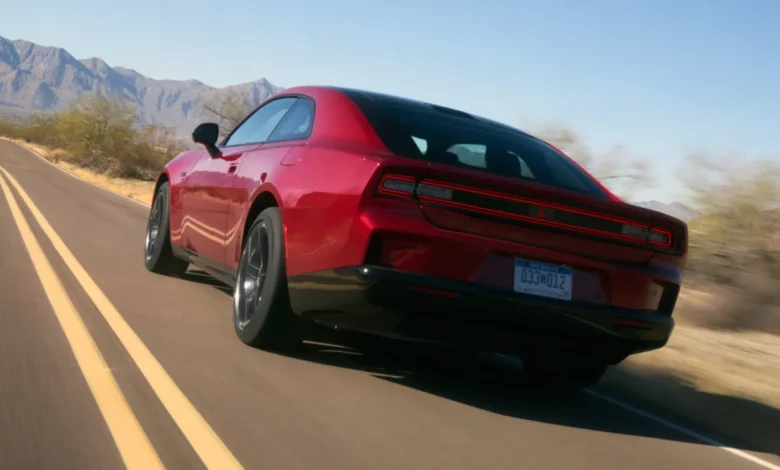
While the patent features design sketches reminiscent of a Dodge Challenger, automotive analysts note that this is likely a placeholder or a reference to the company’s legacy chassis platforms rather than an indication that the specific model will return to production with this feature. The choice of a high-performance silhouette, however, highlights the company’s focus on integrating performance-oriented technology with modern safety requirements.
The broader industry implications are significant. As electric vehicle adoption increases globally, the automotive sector is under mounting pressure from regulators to address the "worst-case scenario" safety profile of high-density battery packs. If the Stellantis system reaches production, it would represent a departure from the "structural battery" trend, where the battery is integrated into the vehicle frame to reduce weight and increase rigidity. Moving back toward a removable, modular design introduces new challenges in terms of chassis stiffness and curb weight, which engineers will need to balance against the safety benefits.
Regulatory and Environmental Considerations
The deployment of such a system is not without potential controversy. Environmental agencies have raised concerns about the unintended consequences of dropping a burning, chemically volatile battery pack onto public roads. In areas prone to wildfires or drought, the prospect of a burning battery pack being left on the asphalt is a significant fire hazard. Furthermore, the cleanup process for a discarded battery involves hazardous material mitigation, which would require specialized response teams beyond standard towing services.
From a regulatory standpoint, the National Highway Traffic Safety Administration (NHTSA) and other international bodies have yet to establish standards for battery ejection systems. The complexity of ensuring that such a system does not trigger accidentally—due to road debris, potholes, or minor collisions—is a primary concern for certification. The patent indicates that the system would likely be governed by a complex set of fail-safes and sensor-fusion algorithms to ensure that the "eject" command is only issued when the risk of fire is verified and imminent.
Chronology of EV Safety Innovation
The progression of battery safety technology has moved through several distinct phases over the last decade:
- 2015–2018: Initial focus on battery enclosure hardening and thermal barriers to prevent external punctures from causing fires.
- 2019–2021: Shift toward software-defined battery management systems (BMS) that use AI to predict and prevent cell-level anomalies before they reach a critical state.
- 2022–2024: Rise of secondary-stage safety, including venting systems that direct smoke away from the cabin and internal cooling loops.
- 2025–Present: Emergence of "extreme mitigation" designs, such as the Stellantis quick-release patent, focusing on total physical isolation as a final resort.
Strategic Outlook
Stellantis has not released an official timeline for the implementation of this technology, and industry experts suggest that patents are frequently filed to secure intellectual property rights for future research and development, rather than as a precursor to immediate deployment. However, the filing highlights a pivot in corporate strategy: acknowledging that despite best-in-class prevention, catastrophic failure remains a statistical possibility that must be managed.
As the automotive landscape shifts away from internal combustion, the ability to effectively manage battery-related incidents will be a defining metric for consumer trust and fleet insurance viability. While the concept of a "drop-away" battery may seem radical, it aligns with a growing consensus that EVs must be designed with "end-of-life" or "emergency-state" disposal in mind. Whether or not this specific mechanism moves from the patent office to the assembly line, the innovation reflects the ongoing evolution of automotive safety engineering in an electrified era. Future iterations will likely focus on refining the trigger criteria and developing standardized protocols for the recovery of the detached battery packs, ensuring that safety innovations do not come at the cost of environmental or logistical complications.