The evolution of the American compact pickup truck: From Detroit’s Japanese bridge to the legacy of the Dodge Ram 50

The automotive landscape of the 1960s was defined by a shift in consumer sentiment. As the American "Big Three"—General Motors, Ford, and Chrysler—navigated a post-war era of massive sedans and oversized aesthetics, they began to recognize a burgeoning niche market. Consumers were increasingly interested in vehicles that offered agility, fuel efficiency, and utility without the logistical burden of full-size vehicles. While the passenger car market saw the introduction of the Chevrolet Corvair, the Ford Falcon, and the Plymouth Valiant, the truck market remained largely static, dominated by heavy-duty workhorses that were often overkill for the average suburbanite or small-scale hobbyist.
The Rise of the Mini-Truck and the Outsourcing Strategy
While Detroit hesitated, international manufacturers saw an opening. Datsun began exporting compact trucks to the U.S. West Coast in the early 1960s, with Toyota following shortly thereafter. These were not the car-based "utes" or forward-control curiosities offered by American firms, but purpose-built, ladder-frame trucks that promised longevity and utility.
By the time the fuel crises of the 1970s struck, the American automakers found themselves at a competitive disadvantage. Their existing offerings—such as the Ford Ranchero or the Corvair-based trucks—were largely perceived as niche lifestyle vehicles rather than genuine utility machines. To bridge the gap, Ford and GM adopted a pragmatic, if reactive, strategy: rebadging existing Japanese platforms. In 1972, Ford introduced the Courier, a rebadged Mazda B-Series, while General Motors debuted the Chevrolet LUV, based on the Isuzu Faster. These vehicles became instant successes, providing the American brands with a foothold in a segment they had failed to develop internally.
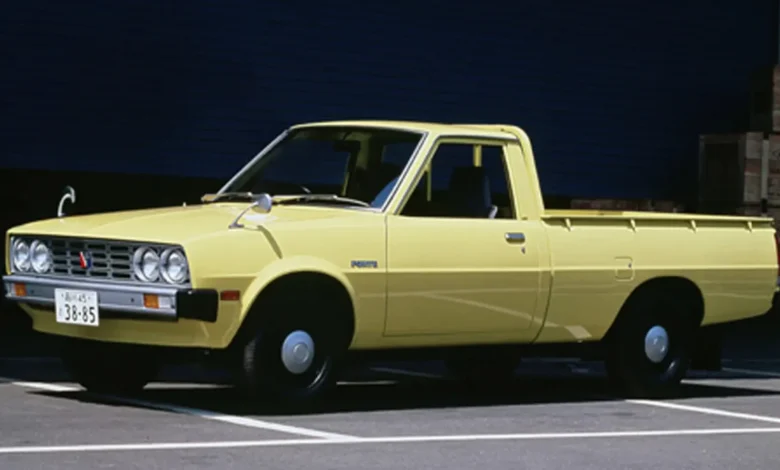
Chrysler, however, remained a step behind. It was not until 1979 that the Dodge D-50, a rebadged Mitsubishi Forte, entered the North American market. This seven-year delay in entering the compact truck segment meant that while the LUV and Courier were already entrenched, the D-50 had to fight for recognition in a market that was quickly becoming crowded.
Dimensions and Performance: The True Meaning of Compact
To understand the Dodge D-50, one must contrast it with modern interpretations of the "compact" vehicle. The term has undergone significant inflation over the last four decades. The 1979 Dodge D-50 boasted a length of 184.6 inches and a width of 65 inches. For historical context, these dimensions are smaller than a 2026 Honda Civic, which measures 184.8 inches in length and 70.9 inches in width.
When compared to the modern Ford Maverick—a vehicle marketed as a "compact" pickup—the D-50 appears significantly more diminutive. The Maverick is approximately 15.2 inches longer, 7.6 inches wider, and 8 inches taller than its 1970s predecessor. This size differential highlights a broader industry trend: as safety regulations, creature comforts, and crash-test requirements have evolved, the physical footprint of vehicles has expanded to accommodate these necessities.
Mechanically, the D-50 utilized power plants that prioritized efficiency over raw output. The base model featured a 2.0-liter overhead-cam inline-four engine producing 93 horsepower and 108 pound-feet of torque, mated to a four-speed manual transmission. For those seeking higher performance, the D-50 Sport trim offered a 2.6-liter I4 engine delivering 105 horsepower and 139 pound-feet of torque, often paired with a five-speed manual or an optional three-speed automatic transmission. Despite these modest figures, the D-50’s utility was surprisingly robust. With a maximum payload of 1,400 pounds in its initial iteration, it offered a practical solution for the light-duty consumer. By 1981, engineering refinements pushed that capacity to 1,525 pounds, effectively surpassing the payload capacity of a modern 2026 Ford Maverick.
Chronology of the Ram 50 and Brand Identity
The year 1981 served as a pivotal moment for Chrysler’s truck division. As the corporation looked to consolidate its identity, it began integrating the "Ram" branding across its truck lineup. The D-50 was rebranded as the Dodge Ram 50, a move intended to align the compact truck with the brand’s heavier-duty offerings.
- 1979: Debut of the Dodge D-50, based on the Mitsubishi Forte.
- 1981: Rebranding to Dodge Ram 50; payload capacity increased to 1,525 pounds.
- 1982: Introduction of 4×4 configuration and the "Power Ram 50" marketing designation.
- 1983–1985: Brief offering of a diesel power plant to address fuel-conscious buyers.
- 1987: Launch of the second-generation Ram 50.
- 1994: Conclusion of production for the Ram 50 series.
The introduction of the 4×4 configuration in 1982 was particularly significant. By marketing the vehicle as the "Power Ram 50," Chrysler tapped into the growing off-road interest among American consumers, positioning the truck not just as a fuel-efficient commuter, but as a legitimate recreation vehicle.
Comparative Analysis: Was the Ram 50 the Smallest?
Despite its compact nature, the Ram 50 was not the smallest pickup in the Dodge portfolio. That distinction belongs to the Dodge Rampage, a coupe-utility vehicle produced between 1982 and 1984. Built on the front-wheel-drive Dodge Omni 024 platform, the Rampage offered a unique aesthetic that merged car-like handling with a small bed.
When measured against the Ram 50, the Rampage was roughly the same length and width, yet it stood 9 inches shorter in height. Its payload capacity was also significantly lower—380 pounds less than the Ram 50. This demonstrates the structural divergence between the two: the Ram 50 was a traditional truck with a ladder frame and rear-wheel drive, while the Rampage was a unibody car-based derivative.
Furthermore, if one looks back at the 1960s, the Dodge A100 forward-control pickup stands out as an even smaller footprint vehicle. Measuring roughly 170 inches in length, the A100 utilized a cab-over design where the driver sat directly above the front wheels. This layout allowed for a significant increase in bed length relative to the total vehicle length, as there was no protruding hood. To put this size into perspective, the A100 was comparable in length to a modern BMW Z4 roadster, proving that Dodge had been experimenting with extreme space efficiency long before the influx of Japanese imports.
Industry Implications and Legacy
The trajectory of the Ram 50 highlights a fundamental truth about the American automotive industry: it often responds to consumer shifts through international collaboration. By leveraging Mitsubishi’s engineering expertise, Chrysler was able to enter the compact truck market without the astronomical R&D costs associated with building a new platform from scratch.
The lasting impact of the Ram 50 and its contemporaries like the LUV and Courier is the validation of the compact truck segment in the United States. While the Big Three eventually moved toward manufacturing their own mid-size and compact platforms—such as the Ford Ranger and the later iterations of the Chevy S-10—the path was paved by these rebadged imports.
Ultimately, the Dodge Ram 50 serves as a case study in market adaptation. It was a vehicle that bridged the gap between the utilitarian, forward-control designs of the 1960s and the modern, lifestyle-oriented pickups of the 21st century. While it may have been an outsourced solution to a pressing domestic problem, it succeeded in establishing a legacy that allowed Dodge to maintain relevance in a segment that has become a staple of the American automotive fleet. The history of the Ram 50 is, in many ways, the history of the American industry’s realization that sometimes, the most effective way to compete globally is to borrow from the experts.
Related posts: