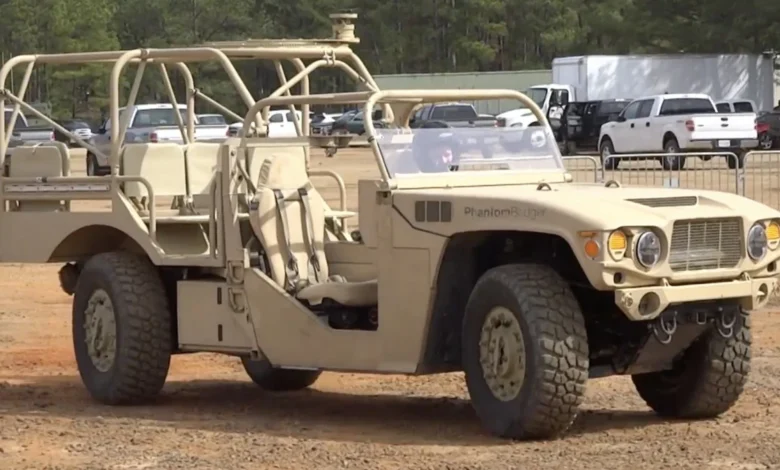
In the realm of modern defense technology, nomenclature often belies the sheer tactical gravity of the hardware being described. Just as the velvet ant belies its innocuous name with a notoriously potent neurotoxic sting, the Boeing Phantom Badger represents a paradox of military engineering: a highly specialized, combat-ready platform that remains one of the most intriguing "what-if" projects in recent American defense history. Developed in 2013 as a collaboration between aerospace giant Boeing and MSI Defense Solutions, the Phantom Badger was envisioned as a light, high-mobility strike vehicle capable of fitting into the cramped, demanding environments of rapid-response special operations. Despite its engineering pedigree and versatile design, the vehicle’s journey from prototype to operational limbo highlights the brutal Darwinian nature of the U.S. military procurement process.
The Genesis of the Phantom Badger
The project began as an answer to a specific logistical challenge faced by the U.S. Marine Corps and the U.S. Special Operations Command (SOCOM). Commanders in the field required a vehicle that could operate in austere, rugged environments but, crucially, could be transported internally by the Bell-Boeing V-22 Osprey. This tiltrotor aircraft, while a technological marvel, features a narrow fuselage that restricts the dimensions of cargo.
Boeing and MSI Defense Solutions initiated the Phantom Badger program to fill this gap. By mid-2013, the partners had unveiled a prototype that prioritized modularity above all else. The goal was to provide small, elite units—often operating deep behind enemy lines—with a platform that could be rapidly reconfigured in the field to handle casualty evacuation, reconnaissance, fire support, or logistics support. By utilizing a "plug-and-play" rear section, the vehicle could be stripped of a medical bed and outfitted with weapon mounts or cargo racks in a matter of minutes, theoretically providing a force multiplier for squads that had to operate with minimal outside support.
Engineering Specifications and Performance Metrics
The Phantom Badger was engineered to be a workhorse, not a luxury cruiser. Beneath its rugged, open-top exterior lies a 3.0-liter multi-fuel V6 turbocharged engine. This powertrain choice was strategic; in theater, refined diesel or high-octane gasoline is not always available, and the ability to run on various fuel grades is a critical logistical advantage. The engine produces 240 horsepower and a substantial 420 pound-feet of torque, providing the necessary grunt to haul heavy loads over treacherous, uneven terrain.
The vehicle’s performance specifications reflect its intended use as a rapid-insertion asset:
- Top Speed: 80 mph on paved surfaces.
- Operational Range: Approximately 450 miles on a single tank.
- Fuel Efficiency: An estimated 21 miles per gallon, a notable figure for a vehicle designed to endure high-stress combat maneuvers.
- Dimensions: At 180 inches long and 60 inches wide, it is specifically tailored for the V-22 Osprey’s cargo bay.
- Weight: 7,850 pounds curb weight.
- Payload Capacity: 3,356 pounds.
The vehicle’s mobility is bolstered by a sophisticated height-adjustable suspension system paired with 35-inch tires, allowing it to navigate water obstacles up to three feet deep. This capability is paramount for units operating in river deltas, flooded plains, or mountainous regions where traditional heavy armor would be bogged down or rendered immobile.
Combat Capabilities and Defensive Armament
Despite its compact footprint—being notably narrower than a standard civilian passenger car—the Phantom Badger was designed to pack a lethal punch. The vehicle supports a primary weapon mount capable of hosting a 12.7mm heavy machine gun or a 40mm automatic grenade launcher. To complement this, the rear hull incorporates two additional swivel stations designed for 7.62mm light machine guns.
The interior layout accommodates five personnel: a driver and front passenger, with three additional soldiers in the rear. The open-top configuration provides excellent situational awareness, a vital requirement for reconnaissance and counter-insurgency operations where the threat can emerge from any direction. However, this lack of overhead armor also underscores the vehicle’s role: it is a "light strike" platform meant for high-speed hit-and-run tactics rather than sustained frontal assaults against entrenched, heavy armor.
The Procurement Hurdle and Operational Fate
By 2014, the Phantom Badger had cleared significant technical hurdles, including certification by the U.S. Navy for transport within the V-22 Osprey. This was no small feat, as the vehicle had to meet stringent vibration, weight, and center-of-gravity requirements to ensure flight safety. Yet, the project encountered a wall when it was submitted for the U.S. Special Operations Command’s Ground Mobility Vehicle (GMV) 1.1 contract.
Ultimately, SOCOM selected the General Dynamics Ordnance and Tactical Systems’ Flyer 72 for the contract. The Flyer 72 offered a different balance of protection, payload, and internal volume that aligned more closely with the evolving requirements of special operations units. Following this rejection, the Phantom Badger effectively entered a state of strategic purgatory. While there is no public record of mass production for the U.S. military, the existence of the platform demonstrated the potential for niche-market military vehicles developed by agile, private-sector partnerships.
Broader Implications for Defense Procurement
The Phantom Badger serves as a poignant case study in the risks of "bespoke" military engineering. When a company develops a platform with a very specific set of constraints—in this case, the dimensions of the V-22 Osprey—it gains a competitive edge for a specific contract. However, if the military’s requirements shift, or if a competitor offers a more modular alternative, the investment can become stranded.
The case also highlights the ongoing tension between "off-the-shelf" procurement and custom development. The Department of Defense has increasingly moved toward purchasing commercially available technologies and modifying them for military use, as custom-built prototypes like the Phantom Badger often carry higher development costs and uncertain long-term support.
Furthermore, the Phantom Badger’s fate reflects the changing nature of asymmetric warfare. As military planners move away from the massive logistics chains of the 20th century toward decentralized, small-unit maneuvers, the demand for vehicles that are both "air-mobile" and "lethal" remains high. While the Phantom Badger may not have seen widespread service, the lessons learned during its development regarding chassis weight, multi-fuel engine reliability, and modular weapon integration continue to influence the design of contemporary Light Tactical Vehicles (LTVs).
Conclusion
While the Phantom Badger may not be remembered as a ubiquitous fixture of the U.S. military arsenal, it remains a testament to the ingenuity of the aerospace and defense sectors. It was a vehicle designed for a future that demanded rapid, agile, and modular intervention. Its existence serves as a reminder that in the high-stakes world of defense, even the most capable machines must contend with shifting strategic priorities, budget constraints, and the constant evolution of tactical doctrine. Whether the design will see a resurgence in a different iteration or remain a historical footnote, the Phantom Badger successfully pushed the boundaries of what a transportable, high-mobility strike vehicle could achieve. For now, it stands as a curious artifact of a time when the military sought to turn the smallest possible vehicles into the biggest possible threats.
Related posts: