The Stadium as the New Public Square How Sports Fandom is Bridging Americas Great Partisan Divide

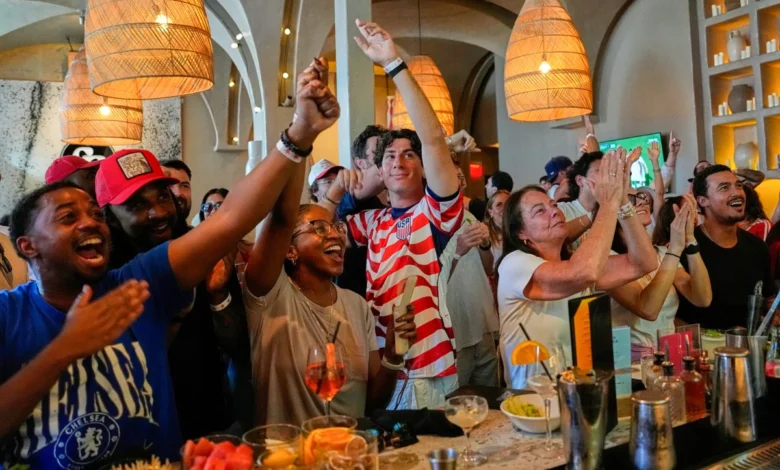
The state of the American social fabric—enormous, diverse, and rent by stark partisan divides—is daunting enough that it can be hard to think about, let alone try to mend. As traditional institutions like religious organizations, civic clubs, and local political chapters face a decades-long secular decline, researchers are searching for new "social glues" that can bind a fragmented population together. At the Harvard Kennedy School (HKS), two social scientists are advancing a proposition that may seem unconventional to the academic establishment: sports fandom, a powerful social phenomenon and force, may have a pivotal role to play in improving lives, reducing loneliness, and strengthening the foundations of democratic societies.
This proposition is undoubtedly controversial within some academic circles and remains significantly underexplored in formal social science literature. To address this gap, a new project launched by Professor Todd Rogers and doctoral student Audrey Feldman aims to quantify the impact of fandom on social cohesion. The "Fandom and Social Connection Initiative" is poised to publish its first wave of findings in the coming months, offering a rigorous behavioral science lens on a topic often dismissed as mere entertainment.
The Scholarly Gap in Sports Research
Despite the cultural ubiquity of sports, the academic world has historically turned a blind eye to the sociological and psychological implications of being a fan. Rogers, the Weatherhead Professor of Public Policy at HKS, and Feldman discovered a startling disparity in scholarly attention. Upon reviewing top journals across the social sciences, they found that only about one in every 800 articles concerned sports. This oversight occurs despite the fact that sports is a multi-billion-dollar global industry and an undeniable social fact.
In the United States, nearly three-quarters of the population reports following at least one professional sports team. For the majority of these individuals, their allegiance to a team is not just a hobby; it is a core component of their personal and social identity. On a global scale, the numbers are even more staggering. Recent data from Nielsen indicates that 51 percent of the global population identifies as fans of soccer alone. While Americans are slightly less fervent about soccer—with approximately 27 percent identifying as fans—major events like the World Cup still capture the attention of 40 percent of the U.S. population.
The Fandom and Social Connection Initiative, backed by a significant gift from FOX Sports, seeks to treat the world of sports as both an observational "green field" and a target for high-impact social intervention. By partnering with professional sports leagues, Rogers and Feldman hope to transform the stadium from a place of passive consumption into a laboratory for social healing.
Fandom as Modern Social Infrastructure
The urgency of this research is highlighted by the decline of what sociologists call "third places"—environments outside of home and work where people gather. As political polarization reaches historic highs, the stadium remains one of the few places where people of disparate backgrounds still congregate in person.
"It’s social infrastructure in a world where there are few—if any—institutions left that are this wide, and deep, and diverse," Rogers noted. This sentiment echoes the work of sociologists like Robert Putnam, who famously chronicled the decline of American civic life in "Bowling Alone." Where political parties and churches once provided a common language for neighbors, sports teams now fill the void.
The initiative’s research highlights how fandom transcends the partisan "echo chambers" that define modern life. In an era where 19 out of 50 state congressional delegations are made up entirely of one party, sports fanbases remain remarkably heterogeneous. For example, Rogers and Feldman found that even the most politically skewed NFL fanbases are diverse compared to the general electorate. The Tennessee Titans, identified as the "reddest" fanbase, still maintain a ratio of two Republicans for every one Democrat. Conversely, the "bluest" fanbase—the Los Angeles Chargers—holds roughly the inverse ratio. In the context of a game, these political labels often become secondary to the shared goal of a victory.
Testing the "De-polarizer" Effect: Game Theory and Fandom
To move beyond anecdotal evidence, Rogers and Feldman applied rigorous game theory to test the effects of shared fandom on interpersonal bias. In a computer-based survey, participants were presented with hypothetical "counter-partisans"—individuals who held views on politics and culture that were diametrically opposed to their own. Participants were then asked to award a "bonus" to one of these individuals.
The results were illuminating. When a participant learned that a counter-partisan shared their favorite sports team, that individual received the bonus at rates that significantly outstripped bonuses given for shared race, ethnicity, education level, or home region. In fact, only shared religion came close to matching the influential power of shared sports fandom.
This suggests that sports fandom functions as an "active and elective" marker of identity. Much like religion, it involves seasonal rituals and a sense of allegiance that people can choose to renew throughout their lives. Even when a team is perennially unsuccessful—Rogers jokingly cited the Cleveland Browns as an example—the "opting-in" continues. This persistence suggests that the motivation for fandom is not necessarily the performance on the field, but the bonds formed with family, colleagues, and neighbors.
The Biological and Psychological Synchronization of Fans
The initiative also draws on the work of Daniel Wann, a professor at Murray State University often referred to as the "godfather of sports psychology." Wann utilizes the metaphor of a "shared photo album" to describe fandom. To follow the same team as a stranger is to share a history and a future. You know where they were during the championship run of 2018, and you know where they will be next season.
This connection may be more than just psychological; it appears to be biological. Rogers pointed to psycho-physiological research suggesting that spectators’ brain activity, specifically EEG readings, starts to synchronize during the highs and lows of a major game. This "neural coupling" creates a sense of collective effervescence, a term coined by sociologist Émile Durkheim to describe the feeling of belonging and excitement that occurs when a group participates in a shared ritual.
Furthermore, sports serve as a "safe" social solvent. Unlike politics or current events, which can be fraught with tension, sports provide a topic that is engrossing and human yet relatively low-risk for social friction. Even in the case of bitter rivalries, there is a baseline of mutual respect. Feldman noted that while she may find a rival team "the worst," the shared language of football allows for a level of communication and engagement that might not exist otherwise. This was supported by draft findings involving the English Premier League, where fans of rival teams like Manchester United and Liverpool indicated they would rather socialize with each other than with someone who does not watch soccer at all.
Real-World Interventions and the "WooSox" Partnership
The Fandom and Social Connection Initiative is not content with purely theoretical work. Rogers and Feldman are already looking for ways to apply their findings to combat the "loneliness epidemic" currently facing the United States. In late 2023, they authored an op-ed for TIME magazine, characterizing NFL fandom as a "simple and universally accessible medicine."
This summer, the researchers are taking their work to the field—specifically to Polar Park in Worcester, Massachusetts. In partnership with the Worcester Red Sox (the "WooSox"), the AAA affiliate of the Boston Red Sox, the team will conduct experiments designed to nudge spectators into conversation with their neighbors in the bleachers. By using subtle behavioral cues and social "nudges," the researchers hope to facilitate meaningful connections between strangers during the game.
Early indications from their experimental work suggest that these interventions are effective. Rogers stated that they have successfully induced 40 percent of study participants to watch games with others. The result was a measurable increase in feelings of social connection that persisted for several weeks after the event.
Implications for Public Policy and Social Health
The implications of this research extend far beyond the sports world. If sports fandom can be proven to reduce social isolation and bridge partisan divides, it becomes a legitimate tool for public policy. At a time when the U.S. Surgeon General has declared loneliness a public health crisis—linking social isolation to increased risks of heart disease, stroke, and dementia—identifying existing social structures that promote connection is vital.
The work at the Harvard Kennedy School suggests that instead of viewing sports as a distraction from "serious" societal issues, we should view them as a primary vehicle for social repair. By reclaiming fandom from its often-maligned status (where non-fans sometimes view passionate fans as less "evolved" on the scale of human development), Rogers and Feldman are highlighting a pathway toward a more integrated society.
As the project moves toward full publication, the goal remains clear: to provide the empirical evidence necessary to convince policymakers, league executives, and the public that the "shared photo album" of sports is a vital asset. In a nation where the public square is increasingly empty or hostile, the stadium bleachers may be one of the last places where we can still learn to be neighbors. Through the lens of behavioral science, the roar of the crowd is not just noise—it is the sound of a community being rebuilt, one play at a time.