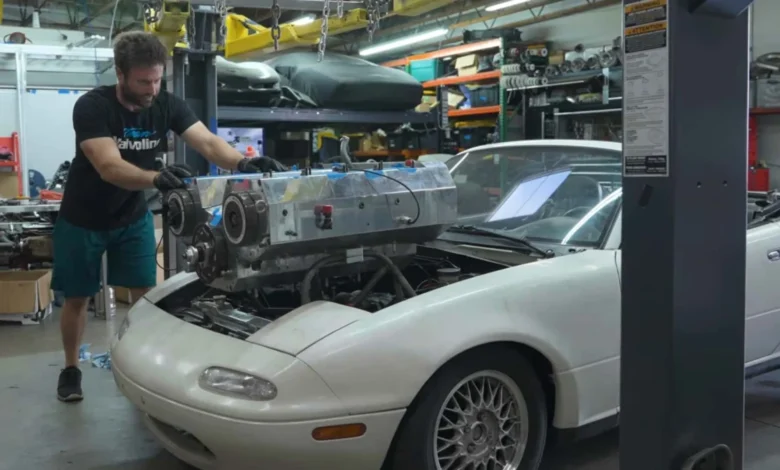
The 2026 SEMA Show in Las Vegas served as the stage for one of the most audacious engineering spectacles in recent automotive history. Renowned automotive content creator and engineer Rob Dahm unveiled a first-generation Mazda MX-5 Miata featuring a staggering 13-rotor configuration. While the visual impact of a 13-rotor engine filling the compact engine bay of a classic roadster drew immediate crowds, the reality of the build is a masterclass in creative engineering and showmanship. By pairing a massive, non-functional 12-rotor display engine with a compact, high-output single-rotor powertrain, Dahm successfully pushed the boundaries of automotive exhibition, creating a machine that is as much a technical puzzle as it is an aesthetic centerpiece.
The Anatomy of the 13-Rotor Build
The core of this project, sponsored by engine management specialist Haltech, relies on a deceptive duality. To the casual observer, the engine bay appears to house a singular, monolithic 12-rotor powerplant, an engine architecture that exists nowhere else in the automotive world. In reality, the 12-rotor assembly serves as a static, albeit highly detailed, display piece. The vehicle’s actual propulsion is provided by a secondary, single-rotor engine equipped with a Garrett GBC22 turbocharger.
This separation of functions allowed Dahm’s team to maintain the visual continuity of a high-performance engine while navigating the physical limitations of the MX-5 chassis. The 12-rotor display engine was fitted with authentic wiring, fuel lines, and peripheral accessories to ensure that onlookers—and even experienced mechanics—would struggle to discern the lack of a traditional mechanical connection to the drivetrain. The project team aimed to create a spectacle that would force attendees to question the laws of physics, specifically how such a massive engine could be packaged into a chassis as small as the Miata’s. The 12-rotor unit, if fully operational, would have boasted a theoretical output of 4,500 horsepower, a figure that highlights the absurdity of the design.
Chronology and Engineering Challenges
The development of the 13-rotor Miata was a high-stakes race against the SEMA Show’s opening date. The project required the fabrication of a custom, triangulated chassis mount system designed to withstand the unique harmonic vibrations and physical weight distribution of two distinct rotary engines. The Miata’s engine bay was never intended to support such a load, and the team faced significant challenges in preventing the chassis from suffering from structural fatigue or excessive "teeter-totter" movement.
The installation process was defined by a specific sequence of operations. Because the engine components—including intake manifolds, custom fuel rails, and three separate turbochargers—were tightly integrated with the chassis bracing, each piece had to be installed in a precise order. Each of the three turbochargers added approximately 70 pounds of weight to the front end, necessitating significant modifications to the suspension geometry to maintain vehicle stability. To meet the aggressive project deadline, the team utilized modular components and wiring harnesses salvaged from previous Dahm rotary projects, effectively treating the build as an iterative design process rather than a ground-up reconstruction.
The final phase of the build, leading up to the November 3, 2026, exhibition opening, was marked by the challenge of logistics. Moving the vehicle was a milestone in its own right. The team had to carefully calibrate the car’s ground clearance to navigate the steep ramps of a transport trailer, a process complicated by the extreme weight imbalance caused by the massive engine assembly. Successfully loading the car became a litmus test for the durability of the custom mounts and the integrity of the chassis modifications.
Technical Data and Performance Metrics
While the 12-rotor engine is a centerpiece for visual impact, the single-rotor propulsion system is a legitimate engineering feat. The Garrett GBC22 turbocharger provides sufficient forced induction to allow the car to be driven under its own power. This, according to the project team, was a non-negotiable requirement for the build. The vehicle had to be capable of moving into position on the show floor without external assistance, ensuring that the presentation remained authentic to the brand’s reputation for functional, albeit extreme, automotive modifications.
The weight penalty of the 13-rotor configuration is significant. Beyond the base weight of the engines, the sheer volume of piping, cooling systems, and specialized engine management hardware required to make the display engine look operational added hundreds of pounds to the vehicle’s curb weight. By utilizing a single-rotor engine for mobility, the team managed to keep the car’s total weight within a range that allowed for controlled movement, even if the vehicle’s performance profile is now entirely secondary to its function as a display piece.
Industry and Public Response
The presence of the 13-rotor Miata at the Haltech booth in the Central Hall of the Las Vegas Convention Center drew significant attention from automotive media and industry professionals. SEMA, known for hosting the most extreme custom builds in the world, proved to be the ideal venue for a project that defies conventional logic.
Industry analysts noted that the project represents a growing trend in the custom automotive sector: the move toward "conceptual engineering." In this space, the primary goal is not necessarily to build a track-ready car, but to create a vehicle that serves as a high-visibility marketing asset. By partnering with Haltech, Dahm leveraged the build to demonstrate the capability of the company’s engine management systems, even in an unconventional application. The ability to manage both the display engine’s aesthetic "life" and the functional operation of the primary rotor engine showcases the versatility of modern electronic control units (ECUs).
Broader Implications for Automotive Customization
The success of the 13-rotor Miata raises questions regarding the future of extreme engine swaps. As electric vehicles continue to gain market share, the culture of internal combustion engine (ICE) modification is becoming increasingly polarized. On one hand, there is a push for efficiency and electrification; on the other, there is a defiant commitment to the mechanical complexity of the internal combustion engine.
Dahm’s build serves as a bridge between these two worlds, albeit through a lens of extreme performance art. The project demonstrates that the limitations of a chassis are only as restrictive as the fabricator’s ingenuity. By utilizing a "decoy" engine to achieve a specific aesthetic goal, the project challenges the industry to rethink how it approaches vehicle builds. It is no longer just about the power-to-weight ratio; it is about the "spectacle-to-reality" ratio.
Furthermore, the logistical hurdles faced by the team—the weight distribution issues, the ground clearance concerns, and the reliance on custom-fabricated bracing—provide a blueprint for future builders attempting to push the boundaries of what can be crammed into a small-displacement platform. The project proves that even the most "absurd" ideas are executable with the right blend of CAD modeling, custom fabrication, and a willingness to accept the inherent risks of such an ambitious undertaking.
Conclusion
The 2026 SEMA Show will be remembered by many as the year Rob Dahm introduced the world to the 13-rotor Miata. While it may not be a vehicle designed for the track or the street, it is a triumph of creative engineering. By successfully blending the lines between a functional machine and a static art piece, the team has managed to captivate the automotive community, proving that even in an era of rapid technological change, there is still room for the sheer, unadulterated madness of internal combustion. As the car remains on display through the final day of the event on November 6, it stands as a testament to the fact that, in the world of high-performance automotive modification, sometimes more is just the beginning.
Related posts: