Prehistoric builders transported the Devils Arrows 11 miles to create a monumental landscape

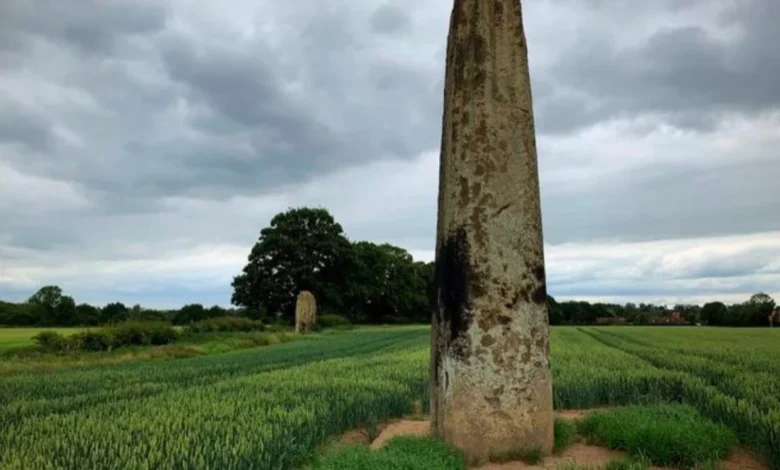
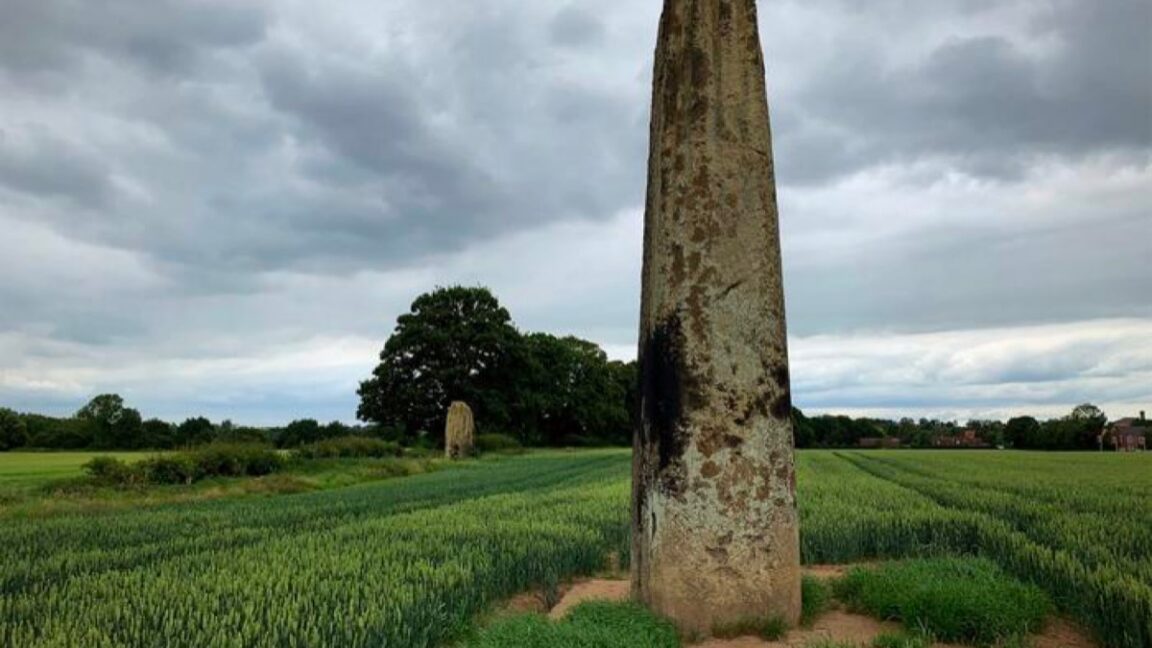
The Devil’s Arrows, a striking trio of towering megaliths located on the western outskirts of Boroughbridge in North Yorkshire, have long been shrouded in folklore and archaeological mystery. For centuries, these stones—the tallest of which reaches an impressive 6.85 meters (22.5 feet)—have been attributed to supernatural origins, with local legend claiming the Devil hurled them across the landscape in a fit of rage. However, a new study published in the Proceedings of the Royal Society A: Mathematical, Physical and Engineering Sciences has stripped away the myth, providing definitive scientific evidence that these monoliths were the result of a deliberate, highly coordinated engineering feat by Neolithic communities.
By employing advanced isotopic analysis, a team of researchers led by Anthony Clarke and Jim Leary of the University of York has successfully traced the geological provenance of the stones to Brimham Rocks, situated 18 kilometers (11 miles) away. This discovery refutes long-standing theories that the stones were sourced from the closer Plumpton Rocks and confirms that prehistoric populations possessed the logistical capabilities and motivation to transport massive 25-ton boulders across a challenging, diverse terrain.
A Chronology of Discovery and Research
The investigation into the Devil’s Arrows is part of a broader, modern scientific endeavor to understand how Neolithic Britain was physically transformed. While Stonehenge has dominated the national archaeological conversation, the Devil’s Arrows have remained comparatively understudied despite their status as the tallest standing stone alignment in Britain.
The recent research builds upon a series of breakthroughs in megalithic studies that began in earnest during the early 21st century. In 2019, chemical analyses of Stonehenge’s bluestones confirmed their origin in the Preseli Hills of western Wales, sparking a decade-long debate regarding the transport methods employed by ancient builders. In 2024, Clarke and his team made headlines by identifying the Stonehenge Altar Stone as originating from the Orkney region in northeast Scotland, a finding that radically altered the perceived scale of prehistoric trade and transit networks.
The current study utilized a rigorous sampling method. Researchers took samples from all three extant stones, as well as from the Battle Cross monument and remnants found at Peg Bridge, using non-invasive adhesive tape techniques to collect grain samples. These samples were subjected to field emission scanning electron microscopy and isotopic fingerprinting of zircon and apatite minerals. The resulting data provided an irrefutable link between the Devil’s Arrows and the geological composition of Brimham Rocks, while simultaneously excluding the possibility of glacial transport—a theory often used to explain the movement of massive stones in the absence of evidence for human intervention.
The Engineering of a Sacred Landscape
The movement of 25-ton stones over 11 miles represents a staggering commitment of labor and resources. Neolithic societies lacked the modern machinery required to move such weight, meaning that the construction of the Devil’s Arrows was likely a communal event that required significant planning, specialized knowledge of friction and leverage, and a cohesive social structure.
"Our research shows these stones weren’t simply taken from the nearest available source—they were deliberately chosen from a challenging landscape 18 kilometers away," said co-author Jim Leary. "Moving them would have required incredible planning, coordination, and engineering skill. This tells us prehistoric people placed real importance on the landscape itself. It wasn’t just about convenience—the location the stones came from likely held meaning for them."
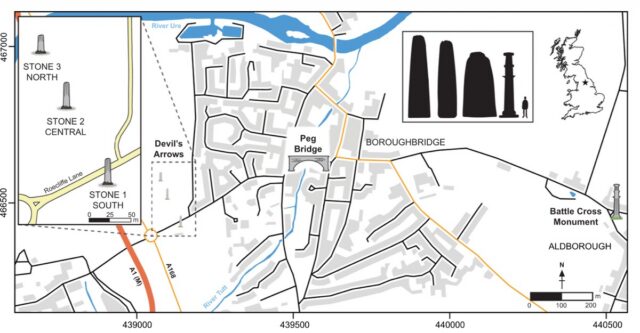
This finding shifts the interpretation of the Devil’s Arrows from mere boundary markers to components of an intentional, sacred geography. Archaeological evidence suggests the stones were aligned with the southernmost summer moonrise, indicating that the site was constructed as an astronomical observatory or a ritual theater. Geophysical surveys conducted in 2025 further support the complexity of the site, revealing magnetic disturbances that point to the presence of two additional stones that have since been removed. Historical records from the 16th and 17th centuries confirm that the original monument was larger, with accounts documenting the toppling and subsequent repurposing of a fourth stone for civil infrastructure, such as the construction of Peg Bridge.
The Biography of a Monolith
The study provides a nuanced look at how megaliths evolve over time. The team confirmed that the Battle Cross monument, which stood in the Boroughbridge market square until the mid-19th century, is composed of a stone originally taken from the Devil’s Arrows alignment. This cycle of repurposing—from a sacred Neolithic monument to a medieval bridge, and later to a civic marker—demonstrates that these stones held enduring, albeit shifting, significance for every generation that interacted with them.
"Reuse does not erase meaning," the researchers noted in their report. "Rather, it adds further episodes to the stone’s biography. A monolith may begin as bedrock, become a selected and transported prehistoric object, acquire significance within a megalithic setting, and later be reimagined as building stone, bridge fabric, a crossing marker, or part of a Christianized or civic landscape. Each phase modifies the interpretive frame. The object is not a static remnant of a single past, but a material witness to repeated acts of human engagement."
Broader Implications for Neolithic Britain
The identification of the source of the Devil’s Arrows carries profound implications for our understanding of the British Neolithic period. It reinforces the idea that prehistoric communities were not isolated, localized groups, but rather dynamic populations capable of sustained, large-scale projects. The effort required to drag or float these massive stones across the North Yorkshire landscape suggests a level of social cohesion and hierarchical organization that many historians previously underestimated.

Furthermore, the rejection of the glacial transport hypothesis for the Devil’s Arrows provides a template for future research. By applying the same zircon and apatite isotopic "fingerprinting" to other standing stones across Ireland and the British Isles, archaeologists may be able to reconstruct the vast, interconnected networks of prehistoric transportation. This evidence points toward a "megalithic culture" that viewed certain quarries and landscapes as inherently sacred, often choosing to transport materials from preferred, distant sites over more accessible local alternatives.
The Devil’s Arrows remain a testament to the ingenuity of their creators. While they no longer serve the purpose for which they were originally erected—the marking of celestial cycles or the anchoring of a spiritual site—they continue to serve as a vital link to the human past. As scientists continue to uncover the histories etched into these stones, the "arrows" are proving to be as much a part of our modern scientific identity as they were a part of the Neolithic world. The collaborative efforts of the University of York and the international research team have transformed a localized, folklore-heavy site into a cornerstone of contemporary archaeological study, proving that the silent stones have much to say about the tenacity and vision of the people who moved them.