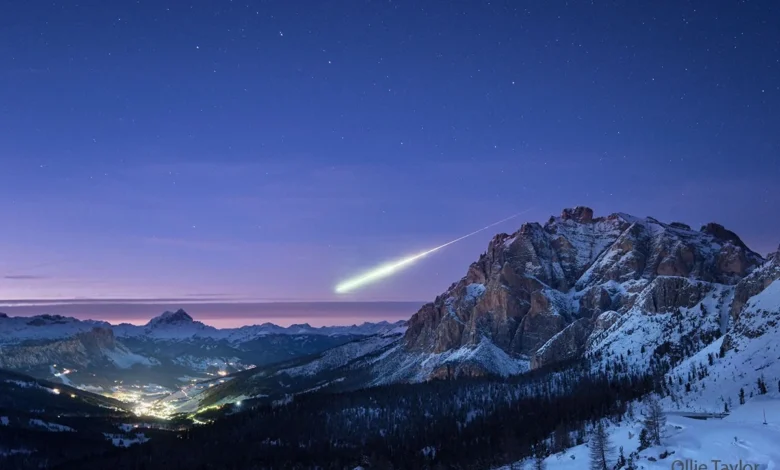
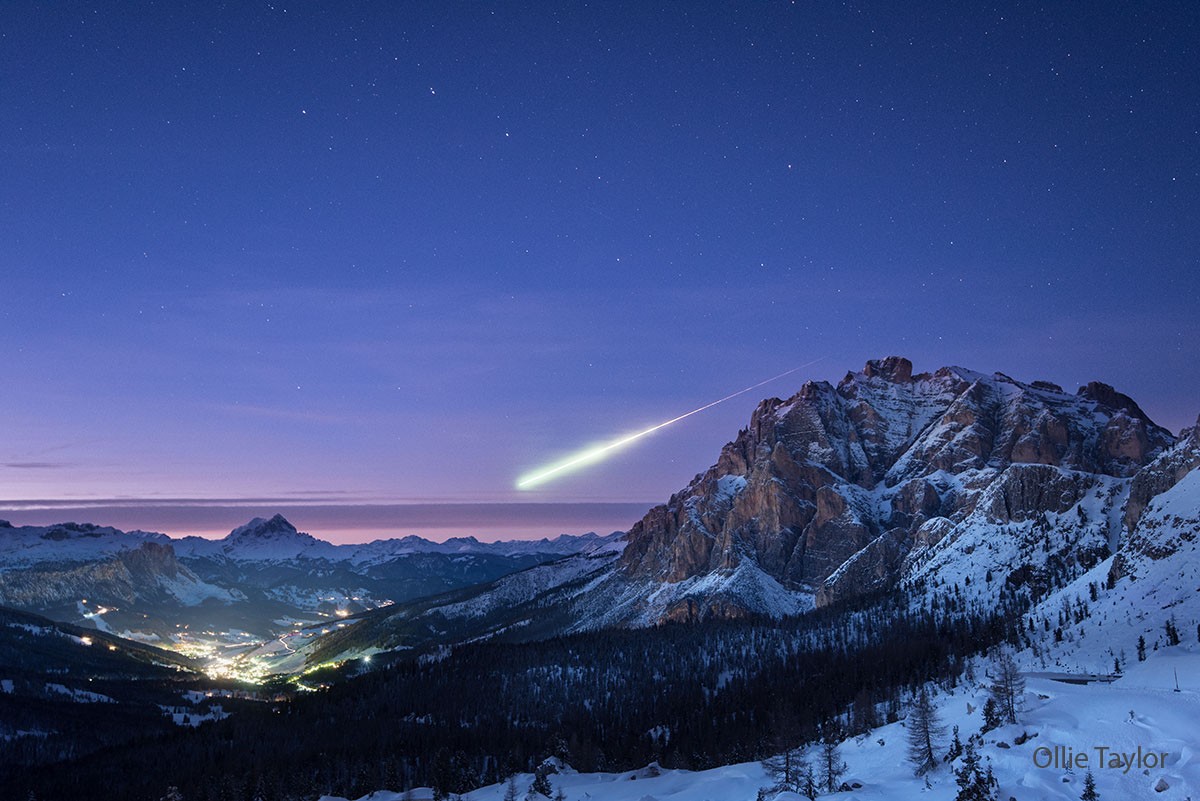
A breathtaking photograph capturing a brilliant fireball meteor streaking across the night sky above Italy’s Dolomite Alps has been selected as NASA’s Astronomy Picture of the Day for November 8, 2026. Captured by astrophotographer Ollie Taylor on November 14, 2017, the image harmonizes terrestrial majesty with transient celestial mechanics, framing an exceptionally rare and widely witnessed atmospheric event against the iconic constellation Ursa Major and the snow-draped peaks of Northern Italy.
The image, distributed globally by NASA’s Astrophysics Science Division at the Goddard Space Flight Center in collaboration with Michigan Technological University, offers a masterclass in serendipitous nightscape photography. Taken under subfreezing conditions from a high-altitude mountain pass, the composition looks down toward the twinkling lights of La Villa in Alta Badia. Along the rugged horizon, a soft, ethereal band of pink twilight fades into the gathering darkness. Hanging prominently overhead is the familiar asterism of the Big Dipper within the constellation Ursa Major. Piercing the frame from east to west is a striking, luminescent meteor trail—a cosmic intruder caught mid-flight by the camera’s open shutter.
Anatomy of an Autumn Fireball
While shooting meteors often requires patience and premeditated timing during major annual showers, Taylor’s capture was largely a stroke of good fortune. The camera was configured to document the serene mountain pass and the fading glow of twilight when the hyper-velocity space rock entered Earth’s atmosphere.
A fireball is scientifically defined by the International Astronomical Union as a meteor brighter than any of the planets, typically reaching magnitude -4 or greater. As dust-to-boulder-sized particles—meteoroids—slam into Earth’s upper atmosphere at velocities ranging from 11 to over 70 kilometers per second, the extreme kinetic energy compresses and ionizes the air molecules in front of them. This creates a searing plasma trail that glows brilliantly, often casting shadows on the ground and leaving persistent ionized smoke trains that can linger for minutes.
In this particular instance, the fireball was not merely a localized curiosity. According to database records maintained by the American Meteor Society (AMS) and the International Meteor Organization (IMO), this specific November 2017 fireball generated an unusually high volume of witness testimonies. It stands as one of the most widely reported singular fireball events in the modern tracking history of both organizations, with hundreds of casual observers and dashboard cameras logging sightings across multiple European nations.
Chronology and Radiant Tracking
The trajectory of the meteor has provided scientists with crucial clues regarding its cosmic origin. Observers across Central Europe, Germany, and Italy tracked the fiery passage, allowing trajectory analysts to reverse-engineer its orbital path through the inner solar system.
The measured track of the meteor over Germany strongly correlates with the radiant point of the Northern Taurid meteor shower, an active annual display that peaks during the month of November. The Taurids are fundamentally linked to Encke’s Comet, a periodic comet with the shortest known orbit of any major comet in our solar system, taking just 3.3 years to complete a single revolution around the Sun.
Over millennia, Comet Encke has shed vast quantities of dusty debris along its orbital path. When Earth intersects these broad streams of cosmic rubble, particles enter the atmosphere at relatively gentle speeds—roughly 29 kilometers per second—yet they are notorious for producing exceptionally bright fireballs due to the density and composition of the larger boulder fragments embedded within the stream.
The Science of Meteor Observation and Planetary Defense
The widespread documentation of the 2017 fireball highlights a critical shift in modern astronomical data collection: the transition from professional-only observatory oversight to decentralized, citizen-science-driven monitoring networks. Organizations like the AMS and the IMO rely heavily on automated all-sky camera networks and crowdsourced eyewitness reports to triangulate trajectories, calculate orbits, and potentially recover fallen meteorites.
When a fireball event generates hundreds or thousands of reports, atmospheric physicists and meteoriticists gain robust datasets to model how interplanetary debris interacts with Earth’s protective gas envelope. Understanding the frequency, size distribution, and structural integrity of incoming meteoroids is vital not only for academic astronomy but also for modern satellite operations. Spacecraft in Low Earth Orbit (LEO) are continuously exposed to the micro-meteoroid environment, making statistical models of meteor showers and sporadic fireballs essential for spacecraft shielding design and mission longevity.
Furthermore, analyzing these events aids planetary defense initiatives managed by agencies like NASA’s Near-Earth Object Observations (NEOO) Program. While the 2017 Taurid fireball posed no threat—vaporizing completely high above the surface—it serves as a persistent reminder that Earth orbits through a debris-laden cosmic highway. Monitoring larger fragments within streams like the Taurids helps astronomers map out "swarm" concentrations that occasionally pose higher impact risks to orbital infrastructure.
Astrophotography in Extreme Environments
Capturing an image of this caliber requires immense technical proficiency and physical resilience. Astrophotographer Ollie Taylor, known for his dramatic framing of night skies over rugged European landscapes, had to contend with extreme subfreezing temperatures in the Dolomite Alps.
Nightscape astrophotography bridges the gap between deep-sky imaging and landscape photography. It demands precise control over camera settings—balancing ISO, aperture, and exposure time to capture faint stellar details, the dim glow of twilight, and sharp terrestrial features without introducing excessive thermal noise or star trailing caused by Earth’s rotation. The inclusion of the cultural landmark of La Villa below provides vital scale, reminding viewers of the vast cosmic theater unfolding quietly above human settlements.
Broader Implications and Public Engagement
The selection of this image by NASA’s Astronomy Picture of the Day editorial team—comprising prominent astronomers Robert Nemiroff, Jerry Bonnell, Cecilia Chirenti, and Keighley Rockcliffe—underscores the agency’s ongoing commitment to public science education. Established in 1995, APOD remains one of the internet’s most enduring and visited educational resources, translating complex astrophysical phenomena into accessible visual art accompanied by rigorous scientific explanations.
By pairing striking visuals with contextual data regarding Comet Encke, the Taurid meteor stream, and fireball physics, NASA continues to foster public curiosity about Earth’s place in the solar system. As commercial space flight expands and our reliance on orbital assets grows, maintaining a culturally resonant and scientifically literate public appreciation for near-space phenomena remains more important than ever.
The immortalization of this transient second in time—where an ancient fragment of a dying comet flashed across the winter constellations above the Italian Alps—stands as a testament to the intersection of human creativity and natural wonder. It captures a fleeting cosmic collision that briefly united thousands of skywatchers across Europe in shared awe, now preserved permanently in the archives of global astronomical history.
Related posts: