Deepest Colony of Animals Ever Observed Discovered in Mariana Trench Challenges Current Models of Ocean Life and Carbon Cycling

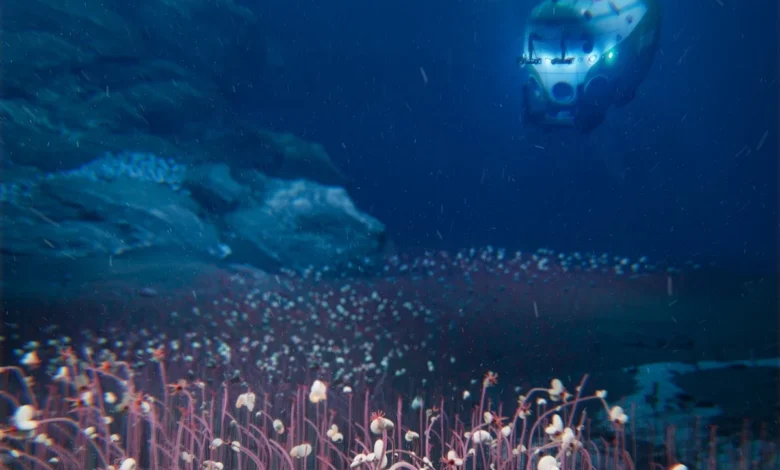
A team of international researchers, led by the Institute of Deep-sea Science and Engineering under the Chinese Academy of Sciences, has documented the deepest and most extensive communities of chemosynthesis-based life ever recorded, situated nearly six miles beneath the surface of the Pacific Ocean. Utilizing the advanced manned submersible Fendouzhe, scientists identified vast colonies of mollusks, tubeworms, and other complex organisms thriving in the extreme conditions of the Mariana Trench, the Kuril–Kamchatka Trench, and the western Aleutian Trench. The findings, published in the journal Nature, reveal a vibrant "oasis" of life in a region of the planet previously thought to be largely desolate, fundamentally altering the scientific understanding of how carbon cycles through the Earth’s deepest oceanic layers.
Discovery in the Hadal Zone
The discovery occurred within the hadal zone—the deepest region of the ocean, extending from 6,000 to 11,000 meters (approximately 3.7 to 6.8 miles) below sea level. In this realm, the water pressure is over 1,000 times that at the surface, temperatures hover just above freezing, and total darkness prevails. Despite these hostile conditions, the Fendouzhe submersible, which conducted 23 dives into the Mariana Trench over the course of the last year, returned with evidence of thriving ecosystems.
Researchers observed thousands of bivalves and siboglinid polychaetes (tubeworms) clustered along geological faults. These communities were not isolated pockets but were found to span a staggering distance of 1,553.4 miles (2,500 kilometers) at depths ranging from 3.6 to 5.92 miles. The scale of these colonies suggests that such ecosystems are far more widespread across the global ocean floor than earlier models of marine biology had anticipated.
The Science of Chemosynthesis in Deep Trenches
Because no sunlight can penetrate to these depths, the organisms do not rely on photosynthesis, the process by which plants and algae convert light into energy. Instead, these deep-sea communities are sustained by chemosynthesis. This process involves microbes that convert inorganic chemicals—specifically methane and hydrogen sulfide—into organic matter that serves as the foundation of the food web.
The study’s lead author, Xiatong Peng, explained that these communities are fueled by fluids rich in hydrogen sulfide and methane. These chemicals are transported along faults that traverse deep sediment layers in the trenches. Isotopic analysis conducted by the team indicated that the methane is produced microbially from organic matter deposited on the seafloor over millennia. This chemical-rich "soup" seeps through cracks in the ocean floor, providing a consistent energy source for microbial mats, which in turn support larger invertebrates.
The researchers found "compelling evidence" of these microbial mats, which appeared as snow-like layers on the seafloor. Tubeworms, some growing up to a foot long, were observed clustering around these mats, while mounds of clams and mollusks occupied the surrounding area. Other observed species included free-floating marine worms, spiky crustaceans, sea lilies, and sea cucumbers, representing a level of biodiversity that rivals shallower hydrothermal vent ecosystems.
Chronology of Mariana Trench Exploration
The exploration of the Mariana Trench has been a rare and technically challenging feat in the history of oceanography. To understand the significance of the Fendouzhe’s findings, it is necessary to look at the timeline of human and robotic descent into the abyss:
- 1960: The first manned descent was achieved by Jacques Piccard and Don Walsh in the Swiss-designed bathyscaphe Trieste. They reached the bottom of the Challenger Deep, the trench’s deepest point, but their stay was brief and visibility was limited, offering only a glimpse of the environment.
- 2012: Hollywood director and explorer James Cameron made the first solo manned descent in the Deepsea Challenger. Cameron described the landscape as "desolate" and "alien," noting a lack of large biological life during his short time on the bottom.
- 2019-2020: The Five Deeps Expedition, led by Victor Vescovo, utilized the submersible Limiting Factor to conduct multiple dives, identifying new species of snailfish and documenting plastic pollution at the bottom of the trench.
- 2023-2024: The Chinese submersible Fendouzhe (meaning "Striver") began a series of intensive missions. Unlike previous "one-off" record-breaking dives, these missions focused on prolonged biological and geological surveying, leading to the discovery of the extensive chemosynthetic colonies reported in 2025.
Supporting Data and Geological Context
The study highlights a critical link between plate tectonics and biological life. The hadal trenches are formed by subduction, where one tectonic plate is forced beneath another. This process creates deep faults and fractures in the Earth’s crust. The research team noted that the geological similarities between the Mariana, Kuril–Kamchatka, and Aleutian trenches are what allow these communities to exist across such vast distances.
According to the isotopic data provided in the Nature study, the carbon found in the tissues of these deep-sea animals directly matches the methane signatures found in the sediment faults. This confirms that the animals are not merely surviving on "marine snow" (organic detritus falling from the surface) but are actively powered by the Earth’s internal chemical processes. This finding challenges current models of the global carbon cycle, as it suggests that the deep ocean is a much more active participant in carbon processing than previously believed.

Official Responses and Researcher Statements
The scientific community has reacted with significant interest to the discovery, noting that it fills a major gap in our understanding of the "hadal" biosphere.
"What makes our discovery groundbreaking is not just its greater depth—it’s the astonishing abundance and diversity of chemosynthetic life we observed," said study co-author Mengran Du, a marine geochemist with the Institute of Deep-sea Science and Engineering. "Unlike isolated pockets of organisms, this community thrives like a vibrant oasis in the vast desert of the deep sea."
Du further reflected on the experience of the descent, comparing the journey to "traveling through time" and unveiling a "hidden world" that had remained a mystery despite decades of oceanographic progress.
The lead author, Xiatong Peng, emphasized the broader implications for oceanography, stating, "Given geological similarities with other hadal trenches, such chemosynthesis-based communities might be more widespread than previously anticipated." This suggests that the total biomass of the deep ocean may need to be upwardly revised in future ecological assessments.
Implications for Deep-Sea Mining and Conservation
The discovery arrives at a time of intense international debate regarding deep-sea mining. Several nations and private corporations are seeking to mine the seafloor for polymetallic nodules—rocks rich in cobalt, nickel, and manganese, which are essential for green energy technologies like electric vehicle batteries.
The International Seabed Authority (ISA), a United Nations-affiliated body, is currently in the process of drafting regulations for these activities. Ocean scientists and environmental advocates have warned that mining could have catastrophic effects on fragile, slow-growing ecosystems. The discovery of vibrant, complex life at six miles deep adds a new layer of urgency to these warnings. Critics of deep-sea mining argue that we cannot protect what we do not yet understand, and the Fendouzhe mission proves that there is still much to learn about the deep-sea’s biological heritage.
The presence of these communities indicates that the deep-sea floor is not a barren wasteland but a series of interconnected, delicate ecosystems. Disturbing the sediment or altering the chemical composition of the water through mining could potentially sever the chemical lifelines that sustain these newly discovered "oases."
Broader Scientific Impact
Beyond the immediate biological discovery, the findings have profound implications for the search for life elsewhere in the universe. Astrobiologists often look to the Earth’s deep oceans as analogs for the icy moons of Jupiter and Saturn, such as Europa and Enceladus. These moons are believed to have subsurface oceans kept liquid by tidal heating, with chemical seeps on their floors similar to those found in the Mariana Trench.
If complex life can thrive six miles deep on Earth through chemosynthesis alone, it increases the statistical probability that similar life forms could exist in the dark, high-pressure oceans of other celestial bodies. The Fendouzhe’s mission has provided a new blueprint for how life can persist at the extreme limits of planetary conditions, moving the needle of biological possibility.
As researchers continue to analyze the samples and video footage brought back by the Fendouzhe, the scientific community remains focused on the Kuril–Kamchatka and Aleutian trenches to see if similar "super-colonies" exist in other unexplored segments of the Pacific Rim. This new era of deep-sea exploration promises to turn the "desolate" abyss into one of the most significant frontiers for biological and geological research in the 21st century.