Geopolitics and Energy Transitions: Navigating the Global Oil Crisis and the Accelerating Pivot to Renewables

The global energy landscape faced a week of intense volatility as a fragile ceasefire between Iran, the United States, and Israel briefly drove oil prices below $96 per barrel before a subsequent attack on Saudi Arabian infrastructure sent markets back into a state of uncertainty. This period of geopolitical instability has underscored a growing consensus among energy experts and international bodies: the world is currently mired in an energy crisis of unprecedented proportions, surpassing the historic shocks of the 20th century. While governments scramble to implement emergency measures to shield consumers from rising costs, the crisis is simultaneously acting as a catalyst for a structural shift toward renewable energy and electric mobility.
A Week of Market Volatility and Geopolitical Friction
The week began with a rare glimmer of diplomatic progress. On Tuesday, an announcement of a two-week ceasefire agreement involving Iran, the U.S., and Israel led to an immediate reaction in global commodities markets. According to reports from the Associated Press, Brent crude and West Texas Intermediate (WTI) prices dipped below the $96-per-barrel mark as traders priced in a reduction in the "war premium" that has haunted energy markets since the outbreak of hostilities in late February.
However, the relief was short-lived. Just hours after the diplomatic breakthrough, Reuters reported a significant kinetic strike against a major Saudi Arabian oil pipeline. The attack, which targeted the East-West pipeline—a critical artery for transporting crude from the Kingdom’s Eastern Province to the Red Sea for export—reintroduced immediate supply-side fears. While damage assessments are ongoing, the event served as a stark reminder of the vulnerability of global energy infrastructure in the face of regional conflict.
This "seesaw" effect in oil pricing reflects a broader fragility in the global economy. Market analysts suggest that while ceasefires offer temporary psychological relief to investors, the underlying physical risks to production and transit routes, particularly near the Strait of Hormuz, remain the primary drivers of long-term price speculation.
The Magnitude of the Current Crisis
The severity of the current situation was contextualized this week by Fatih Birol, the Executive Director of the International Energy Agency (IEA). Speaking to the French publication Le Figaro, Birol stated that the world is currently experiencing an energy crisis "worse than those of 1973, 1979, and 2022 combined."
Birol’s assessment is based on the scale and complexity of modern energy interdependence. Unlike the oil shocks of the 1970s, which were largely confined to petroleum, or the 2022 crisis, which was primarily a regional natural gas and oil shock stemming from the invasion of Ukraine, the current 2026 crisis involves a simultaneous disruption across multiple energy commodities and geographical fronts. Birol noted that the "world has never experienced a disruption to energy supply of such magnitude," pointing to the convergence of military conflict, infrastructure sabotage, and the ongoing structural transition away from carbon-intensive fuels.

Chronology of Key Developments: April 2026
- April 6 (Monday): IEA Chief Fatih Birol issues a warning in Le Figaro, characterizing the current energy disruption as the most severe in modern history.
- April 7 (Tuesday): A two-week ceasefire agreement is announced between Iran, the U.S., and Israel. Oil prices drop below $96/barrel.
- April 7 (Tuesday): The Society of Motor Manufacturers and Traders (SMMT) releases data showing record-breaking electric vehicle (EV) sales in the UK for March.
- April 8 (Wednesday): A Saudi Arabian East-West oil pipeline is hit in an attack; price volatility resumes as damage is assessed.
- April 9 (Thursday): Analysis reveals that over 60 nations have now implemented emergency energy-saving or price-subsidy measures since the start of the conflict.
- April 10 (Friday): UN Climate Change Executive Secretary Simon Stiell calls for increased international cooperation to stabilize energy prices through renewable investment.
National Responses: Balancing Survival and Sustainability
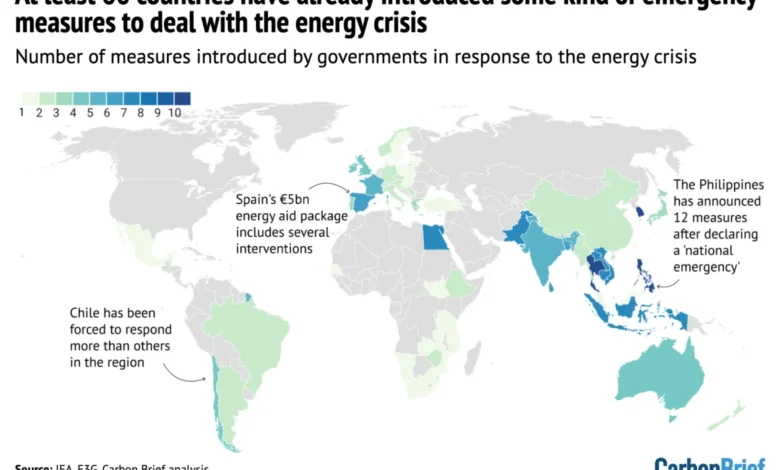
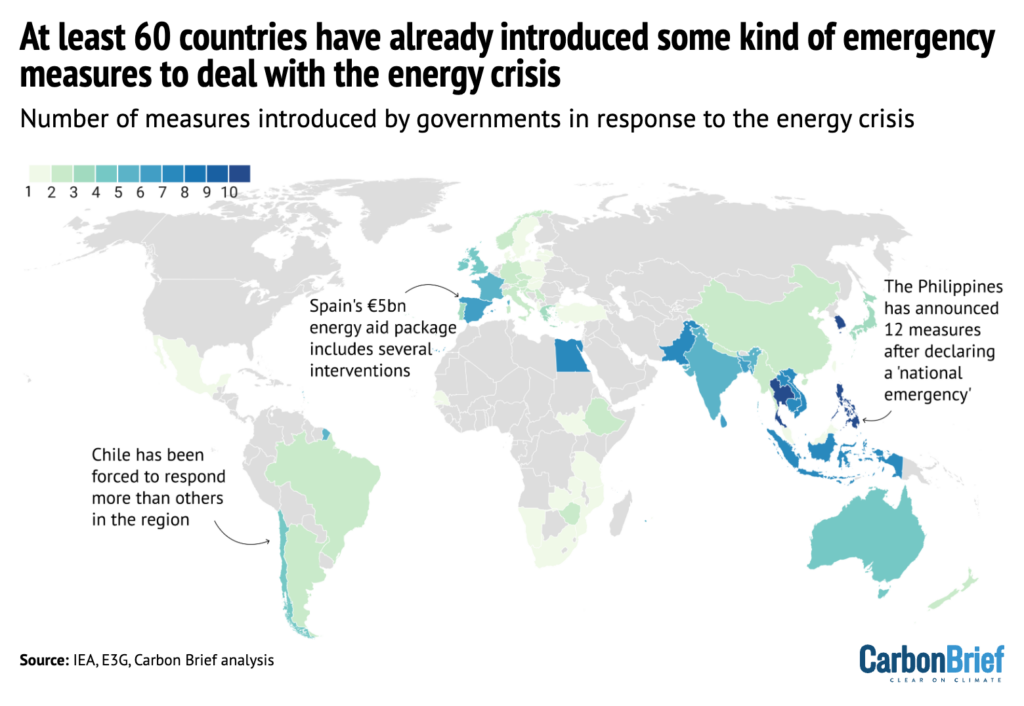
As the crisis deepens, national governments are adopting a two-pronged strategy: immediate relief for citizens and long-term restructuring of energy portfolios. According to an analysis by Carbon Brief, at least 60 countries have announced nearly 200 emergency energy-saving measures since the conflict began in late February.
The most common domestic policy response has been the reduction of fuel taxes. Approximately 30 nations, ranging from high-income economies like Norway to developing nations like Zambia, have slashed duties at the pump to alleviate the cost-of-living crisis for their populations. While these moves are politically necessary, economists warn they may strain national budgets and potentially delay the "price signal" needed to encourage energy conservation.
In terms of power generation, the response has been fragmented:
- Short-term Fossil Fuel Reliance: Nations such as Japan, Italy, and South Korea have signaled a temporary "lean" toward coal-fired power to ensure grid stability and reduce dependence on volatile natural gas and oil markets.
- Renewable Acceleration: Conversely, many European and Southeast Asian nations are doubling down on domestic renewable energy construction. The South China Morning Post reported that the diversification of energy sources is accelerating as uncertainty surrounding the Strait of Hormuz—a chokepoint through which 20% of the world’s oil passes—makes energy security synonymous with energy independence.
The UK’s Record-Breaking Shift to Electric Vehicles
Amidst the turmoil in the fossil fuel sector, the United Kingdom has provided a significant data point regarding the pace of the energy transition. The Society of Motor Manufacturers and Traders (SMMT) reported that March 2026 saw a record 86,120 battery electric vehicle (BEV) registrations. This figure represents 22.6% of the total car market, the highest market share for EVs in the country’s history.
The surge is attributed to "plate change March," a traditional peak in the UK automotive calendar, but it also reflects a deeper consumer shift. As petrol and diesel prices remain high and volatile, the total cost of ownership for electric vehicles has become increasingly attractive. Industry experts suggest that this trend is likely to be mirrored in other major markets as the "polluter’s profit"—the high margins currently enjoyed by fossil fuel extractors—continues to drive consumers toward cheaper, electrified alternatives.
Cultural Communication: Drag as a "Trojan Horse" for Climate Action
While technocrats and economists debate policy, a different form of climate advocacy is gaining traction in the cultural sphere. Drag artists are increasingly using their platforms to engage audiences with the complexities of climate change, employing what British performer Cheddar Gorgeous describes as a "Trojan horse" strategy.
By blending entertainment, joy, and satire with environmental messaging, these performers aim to bypass the "doom and gloom" fatigue that often hampers climate communication. Pattie Gonia, an American drag artist and environmentalist, has been at the forefront of this movement. Her environmental drag show, "SAVE HER!", has helped raise over $4.7 million for LGBTQIA+, BIPOC, and environmental non-profits.
During a recent TED talk, Pattie Gonia argued that "the problem in the climate movement isn’t just the abundance of carbon; it is the lack of joy." She posits that while scientific facts and dire warnings are necessary to wake people up, joy and community building are what sustain long-term activism. This cultural shift is even permeating mainstream media, with climate change becoming a recurring theme on hit shows like RuPaul’s Drag Race, where contestants have used challenges to educate viewers on global warming and scientific consensus.
Implications and Future Outlook
The current convergence of war, energy shortages, and climate urgency has placed the global community at a crossroads. The "polluters’ profit" mentioned by The Guardian highlights a bitter irony: while the world’s largest emitters and fossil fuel companies are reaping massive rewards from high prices, they also hold the key to the infrastructure investments required for a transition.
The long-term implications of this week’s events are three-fold:
First, the fragility of the oil market will likely lead to a permanent "security premium" in energy pricing. As long as key transit routes like the Strait of Hormuz remain under threat, the economic argument for decentralized, domestic renewable energy becomes unassailable.
Second, the record EV sales in the UK and similar trends elsewhere suggest that the transition to clean transport is reaching a tipping point. As infrastructure improves and the price gap between internal combustion engines and EVs closes, the "pivot to renewables" described by the South China Morning Post will likely move from a policy goal to a market-driven inevitability.
Finally, as UN Climate Change Executive Secretary Simon Stiell argued in the Indian Express, the only viable path out of "energy price chaos" is international cooperation. Whether through shared technology, synchronized carbon pricing, or collective security for energy routes, the crisis of 2026 has demonstrated that no nation can achieve energy security in isolation.
As the two-week ceasefire continues to be tested by regional skirmishes and infrastructure attacks, the world remains in a state of high alert. The lessons of 1973 and 1979 are being relearned, but this time with a clear alternative on the horizon: a global energy system that is not only more sustainable but more resilient to the whims of geopolitical conflict.