Hidden Networks of Life: Why Scientists are Calling for Urgent Protection of Earth’s Underground Fungal Systems

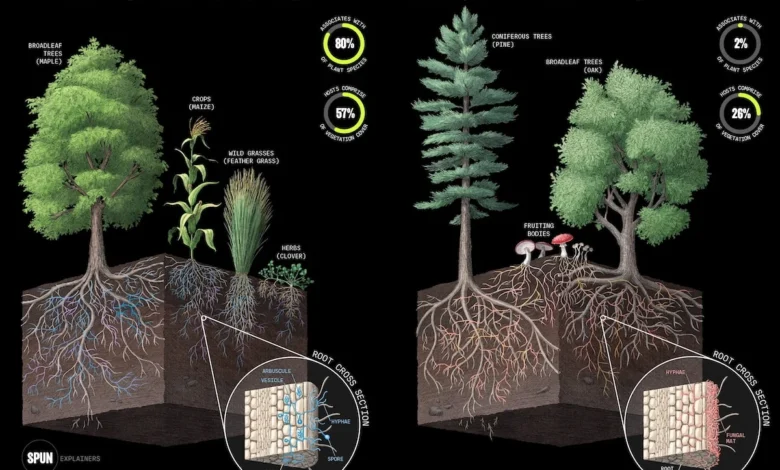
The silent, intricate webs that underpin almost every terrestrial ecosystem on Earth are currently facing a crisis of invisibility. A landmark study published in the journal Nature has revealed that the vast majority of the world’s mycorrhizal fungal biodiversity hotspots—vital to plant health, soil stability, and global carbon sequestration—remain entirely unprotected by existing conservation policies. According to researchers from the Society for the Protection of Underground Networks (SPUN), this "fungus blindness" in policy and environmental management poses a significant threat to global food security, climate change mitigation efforts, and the long-term resilience of the planet’s biosphere.
By leveraging a massive dataset of over 2.8 billion fungal sequences spanning 130 countries, scientists have successfully mapped the underground communities that have functioned as the planet’s "circulatory system" for over 450 million years. The study, titled "Global hotspots of mycorrhizal fungal richness are poorly protected," marks the first time that large-scale, high-resolution predictive mapping has been applied to these subterranean ecosystems. The data shows that 90 percent of these critical biodiversity hotspots lie outside of current protected area designations, leaving them vulnerable to land-use changes, industrial agriculture, and the broader impacts of the climate crisis.
The Evolutionary Foundation of Terrestrial Life
To understand the urgency of this research, one must recognize the evolutionary history of mycorrhizal fungi. These organisms were the silent facilitators that allowed plants to colonize land hundreds of millions of years ago. By forming symbiotic relationships with plant roots—exchanging essential nutrients like phosphorus and nitrogen for plant-derived sugars—these fungi enabled the development of the complex vegetation that covers our planet today.
Dr. Toby Kiers, Executive Director of SPUN, emphasizes that the relationship is foundational to human survival. "450 million years ago, there were no plants on Earth, and it was because of these mycorrhizal fungal networks that plants colonized the planet and began supporting human life," Kiers noted. Today, these networks are responsible for drawing approximately 13 billion tons of carbon into the soil annually—an amount equivalent to roughly one-third of global fossil fuel emissions. When these networks are disrupted through soil degradation or deforestation, the natural capacity for forests to regenerate is severely hampered, crop yields decline, and the ability of ecosystems to buffer against climate extremes is compromised.
A Chronology of Discovery and Mapping
The push to map these networks is a relatively recent, albeit rapidly accelerating, endeavor. While scientists have known about the existence of mycorrhizal fungi for over a century, the technology to visualize them on a global scale was historically unavailable.

- 2021: SPUN is formally launched with the goal of creating a "world atlas" of underground biodiversity. The initiative brings together a global network of "Underground Explorers" and researchers to sample remote soils.
- 2023-2024: The network expands to include over 400 scientists across 80 countries. Fieldwork is conducted in diverse and challenging terrains, including the forests of Bhutan, the savannas of Brazil, and the temperate rainforests of Tasmania.
- July 2025: The publication of the Nature study represents the first major scientific application of the project’s data. The research team unveils predictive maps that allow policymakers to visualize underground biodiversity patterns for the first time.
The sheer scale of the effort is unprecedented. The current SPUN dataset includes more than 40,000 physical specimens representing 95,000 distinct mycorrhizal fungal taxa. Despite this, researchers acknowledge that this represents only 0.001 percent of the Earth’s surface. The maps, however, provide a statistical framework for what the rest of the planet’s underground communities likely look like, providing a blueprint for future conservation efforts.
The Gap in Global Conservation Strategy
The most alarming finding of the recent research is the stark mismatch between where fungal biodiversity is highest and where legal protection exists. Currently, only 9.5 percent of identified fungal hotspots are located within legally protected areas, such as national parks or nature reserves.
This oversight is not merely a scientific concern; it is a policy failure. Conservation agendas have historically prioritized "charismatic megafauna" or aboveground vegetation, such as old-growth forests, while ignoring the subterranean infrastructure that supports those very entities. Dr. Merlin Sheldrake, Impact Director at SPUN, suggests that these new maps are essential tools for "alleviating fungus blindness." By making the invisible visible, the research provides a basis for creating "underground conservation corridors" that could link existing protected areas, ensuring that the health of the soil matches the health of the canopy.
Implications for Climate and Agriculture
The implications of failing to protect these networks are multifaceted. First, in the realm of climate change, the loss of soil-based carbon storage could lead to a feedback loop where damaged soils release more carbon rather than sequestering it. Second, agricultural productivity is intrinsically linked to these networks. Conventional farming practices, which often rely on heavy tilling and chemical fertilizers, can inadvertently destroy the delicate fungal filaments that help plants access water and nutrients.
Dr. Michael Van Nuland, the lead data scientist at SPUN, argues that these maps should serve as a fundamental resource for land management. "Food security, water cycles, and climate resilience all depend on safeguarding these underground ecosystems," Van Nuland stated. By identifying which regions harbor unique, endemic fungal communities, governments can prioritize interventions in areas where restoration could yield the highest ecological return.
Scientific and Advisory Consensus
The initiative has garnered support from a wide array of influential figures in the conservation and environmental space. Prominent advisors to the work include Jane Goodall, author and journalist Michael Pollan, and Fungi Foundation founder Giuliana Furci. Their involvement signals a broader shift in the environmental movement, moving away from a strictly "aboveground" perspective toward a holistic "Earth-systems" approach.

Dr. Alex Wegmann of The Nature Conservancy highlights the practical utility of these findings for land managers. Historically, restoration projects—such as replanting a deforested area—have been "dangerously incomplete" because they ignored the soil microbiome. With high-resolution maps now available, restoration managers have clear, quantitative targets. They can now assess what kind of fungal communities should be present in a healthy ecosystem, allowing them to facilitate the reintroduction of specific fungal strains to boost recovery rates.
The Path Forward: Integrating Data into Policy
The ultimate goal of the SPUN initiative is to ensure that underground biodiversity becomes as fundamental to environmental decision-making as satellite imagery of forest cover. For policymakers, the maps provide a search tool to identify ecosystems that may have been overlooked due to their lack of "surface-level" beauty, but which perform essential ecological functions.
The international community is currently at a juncture where biodiversity loss is being recognized as a systemic risk to the global economy. As countries move to meet the goals of the Kunming-Montreal Global Biodiversity Framework, the integration of fungal biodiversity into these targets will be essential.
As the project enters its next phase, the focus will shift from mapping to implementation. The data is currently being integrated into environmental risk assessment tools, allowing NGOs and government bodies to better evaluate the impact of infrastructure projects on soil health. While the task of protecting a global, microscopic network is daunting, the researchers remain optimistic. By shifting the focus from the canopy to the roots, humanity may yet secure the unseen foundation that supports life on Earth.
The research stands as a clarion call: the future of the planet’s climate resilience and food security is buried beneath our feet, and it is time for our conservation strategies to reflect that reality. Whether these maps will successfully influence international policy remains to be seen, but for the first time, the evidence is undeniable, accessible, and impossible to ignore.