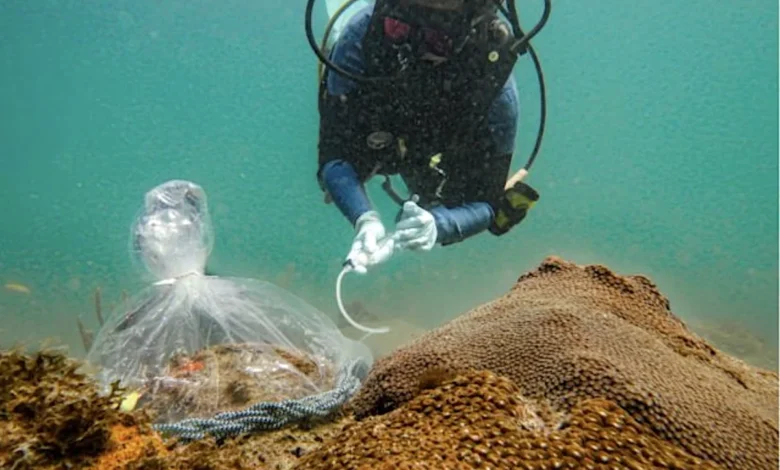
Probiotic treatment of Montastraea cavernosa colonies using a whole-colony bagging technique

The rapid decline of Florida’s coral reefs, exacerbated by the relentless advance of Stony Coral Tissue Loss Disease (SCTLD), has prompted a breakthrough in marine conservation. A recent study published in the journal Frontiers in Marine Science details a promising intervention strategy involving the application of a beneficial bacterial probiotic to Montastraea cavernosa, commonly known as the great star coral. This research, led by scientists at the Smithsonian Marine Station, suggests that a targeted, whole-colony bagging technique could significantly mitigate tissue loss, offering a glimmer of hope for the survival of Caribbean reef ecosystems.
The Emergence and Impact of SCTLD
Since its initial observation near Miami in 2014, Stony Coral Tissue Loss Disease has decimated coral populations across the Florida Reef Tract. Characterized by rapid lesion formation and the systematic sloughing of coral tissue, SCTLD is noted for its high mortality rates and ability to infect a wide variety of reef-building species. Unlike many other coral diseases that are temperature-dependent or seasonal, SCTLD is highly transmissible and has persisted year-round, leading to the functional extinction of several coral species in certain regions.
The disease is believed to be caused by a pathogen—or a consortium of pathogens—that severely compromises the coral’s immune system, leaving it vulnerable to secondary infections. As the disease spreads, the structural integrity of the reef is lost, which in turn diminishes the coastal protection, biodiversity support, and economic value provided by these marine habitats. For years, researchers have sought effective, scalable treatments, with early efforts focusing on antibiotic pastes applied to individual lesions. While these pastes showed initial success in arresting the spread on treated spots, they often failed to prevent the disease from re-emerging elsewhere on the same colony.
Discovery of the MCH1-7 Probiotic
The core of the recent breakthrough lies in the identification of a bacterial strain known as MCH1-7. Discovered in 2018 by the Smithsonian Marine Station, this strain was isolated from a coral colony that exhibited a remarkable, natural resistance to SCTLD. Subsequent analysis revealed that MCH1-7 produces a secondary metabolite called tetrabromopyrrole (TBP).
TBP is a biologically active compound known to function as a settlement cue for coral larvae, but its role as an antimicrobial agent has only recently been fully explored. Jennifer Sneed, a biologist at the Smithsonian Marine Station, noted the ecological synergy of this discovery: "If TBP is a natural settlement cue, and if bacteria that also produce this compound protect corals from disease, it makes sense that larvae would settle where those compounds are being produced. More of them would survive to be able to recognize the compound." This suggests that the probiotic not only serves as a defense mechanism for existing adult colonies but may also foster a healthier recruitment environment for future generations of corals.
Experimental Methodology: The Bagging Technique
To evaluate the efficacy of the MCH1-7 probiotic, the research team implemented a comparative study on Montastraea cavernosa. Two distinct application methods were tested. The first involved a localized paste, similar to traditional antibiotic applications, applied directly to active lesions. The second was an innovative "whole-colony bagging" technique. In this process, divers placed a weighted, flexible bag around the entire coral colony, creating a temporary, isolated environment. The probiotic was then injected into the seawater trapped within the bag, ensuring the entire surface of the coral was exposed to the beneficial bacteria for a set duration.
The experiment was rigorous, involving monitoring periods that extended for 2.5 years post-application. This longitudinal approach provided critical data on the long-term viability of the treatment, distinguishing it from studies that only measure short-term outcomes. The findings were stark: colonies treated via the bagging method experienced an average tissue loss of only 7%, whereas untreated control colonies suffered an average loss of 35%.
Analysis of Findings and Comparative Efficacy
The data suggests that the whole-colony bagging approach is significantly more effective than targeted paste applications. The failure of the paste to stop disease progression suggests that SCTLD may be systemic or that the pathogen can easily bypass localized barriers. By treating the entire colony, the bagging method appears to bolster the coral’s overall microbiome, providing a systemic defense that inhibits the pathogen’s ability to colonize new, healthy tissue.

While the bagging method requires more labor, material transport, and time for deployment and retrieval by divers, the performance metrics justify the increased effort. The research team concluded that the long-term resistance offered by this method outweighs the logistical costs. Furthermore, the researchers conducted assessments to ensure the treatment did not negatively impact the surrounding marine environment, confirming that the probiotic was safe for other common Caribbean coral species.
Implications for Future Conservation
The path forward for coral restoration is complex. Kelly Pitts, the lead author of the study, emphasized that while this represents a significant advancement, it is not a "cure-all." The findings underscore the reality that there is no singular solution for the global decline of coral reefs. Instead, success will likely depend on a multi-faceted approach that combines probiotic treatments, genetic restoration, and the mitigation of broader environmental stressors like ocean warming and acidification.
The study also raises questions about scalability. As of now, the bagging method is a manual, diver-intensive process. For this technique to be applied at a scale sufficient to protect the entirety of the Florida Reef Tract, further innovation in underwater robotics or automated deployment systems may be necessary. Furthermore, the researchers noted that the efficacy of the treatment can vary between species, requiring additional studies to tailor probiotic cocktails for the diverse range of corals impacted by SCTLD.
Official Responses and Industry Outlook
The scientific community has reacted with cautious optimism. Environmental advocacy groups and marine resource managers have highlighted the study as a pivot point in how we approach coral health. By shifting the focus from reactive, localized surgery to proactive, microbiome-based defense, scientists are mirroring agricultural and medical advancements that have long utilized beneficial bacteria to suppress disease.
As the scientific community prepares for subsequent trials, the focus will likely shift toward refining the concentration of the probiotic and optimizing the "dwell time" within the bagging apparatus. The Smithsonian Marine Station and its partners have underscored that this work is in its nascent stages. The 2.5-year observation window, however, provides a robust evidence base that will guide future regulatory and conservation efforts.
The Broader Context of Marine Biodiversity
The preservation of Montastraea cavernosa is of critical importance to the health of the Caribbean and Atlantic reef systems. As a long-lived, slow-growing species, its loss represents a permanent change to the structural complexity of the seafloor. The success of the MCH1-7 probiotic is therefore not just a victory for one species, but a fundamental proof-of-concept for the broader application of synthetic biology and microbiology in reef conservation.
As the climate continues to change, the pressure on coral reefs will only intensify. The work conducted by Pitts, Sneed, and their colleagues provides a template for future research: identifying naturally resistant organisms, isolating the biochemical mechanisms of that resistance, and engineering delivery systems that respect the delicate balance of the marine ecosystem.
In conclusion, while the threat of Stony Coral Tissue Loss Disease remains critical, the development of the whole-colony bagging technique offers a standardized, evidence-based pathway for intervention. It shifts the paradigm from watching reefs fade away to actively reinforcing their biological defenses. As the researchers continue to build upon these results, the global community of conservationists remains attentive, looking for the next milestones in what is effectively a race against time to save the world’s most vital marine ecosystems. The next phase of research will be essential in determining how these laboratory successes can be translated into large-scale, sustainable restoration programs that secure the future of our oceans.