ISpring Water Systems Unveils the BRO900: A High-Capacity Seawater Desalination System Designed to Transform Marine Water Security


For seasoned mariners, offshore commercial crews, and coastal residents navigating the unpredictable waters of off-grid voyages, a singular reality has always dictated the terms of survival and comfort: fresh water is as precious as gold. Whether a vessel is anchored in a secluded, remote cove, cruising between distant marinas, or undertaking grueling trans-oceanic crossings, maintaining a reliable, high-yield source of potable water remains one of the most critical logistical challenges of life at sea. Historically, managing this vital resource required cumbersome storage tanks that consumed precious cargo space, weighed down hulls, compromised fuel efficiency, and ultimately limited a vessel’s cruising range.
Addressing this enduring maritime challenge head-on, iSpring Water Systems—a globally recognized leader in residential and commercial water filtration technology—has officially announced its strategic expansion into marine water treatment. The centerpiece of this industrial pivot is the introduction of the iSpring BRO900, a professional-grade seawater desalination system engineered specifically to withstand the punishing realities of the open ocean. By bridging advanced industrial filtration mechanics with a practical, space-saving footprint, the BRO900 promises to convert ambient seawater into clean, safe, and great-tasting drinking water for crews, passengers, and daily onboard operational needs. Scheduled for an official global launch on October 20, 2026, the system represents a significant technological leap forward for marine life support systems.
Background Context and the Evolution of Marine Desalination
The history of securing fresh water at sea spans centuries, evolving from rudimentary solar stills and chemical purification tablets to energy-intensive thermal distillation units used aboard large naval vessels and commercial cargo ships. In recent decades, the advent of reverse osmosis (RO) technology revolutionized smaller-scale marine applications, allowing recreational yachts and commercial fishing boats to generate fresh water on demand. However, traditional marine desalinators have frequently battled persistent industry-wide shortcomings: susceptibility to rapid biofouling, mechanical vulnerability to the rolling and pitching of a vessel, complex maintenance protocols, and high energy consumption that strains onboard electrical grids.
Recognizing these operational bottlenecks, iSpring Water Systems spent years researching the unique environmental stressors faced by marine equipment. Seawater is not merely salty; it is a highly corrosive matrix of dissolved minerals, organic matter, microorganisms, and suspended particulates that aggressively degrade metallic and synthetic components. Furthermore, the constant motion of a vessel—manifested through sudden drafts, shifts in speed, and rough sea states—often starves standard intake pumps of a consistent water supply, leading to pressure fluctuations that can rupture delicate membranes.
The development of the BRO900 was born out of a corporate mandate to engineer an all-in-one solution that mitigates these vulnerabilities. By integrating multi-stage mechanical pre-filtration, intelligent electronic monitoring, automated maintenance cycles, and robust pressure regulation into a single, compact modular unit, iSpring aims to redefine reliability standards for auxiliary water production on boats, yachts, and commercial coastal vessels.

Advanced 5-Stage Filtration Architecture
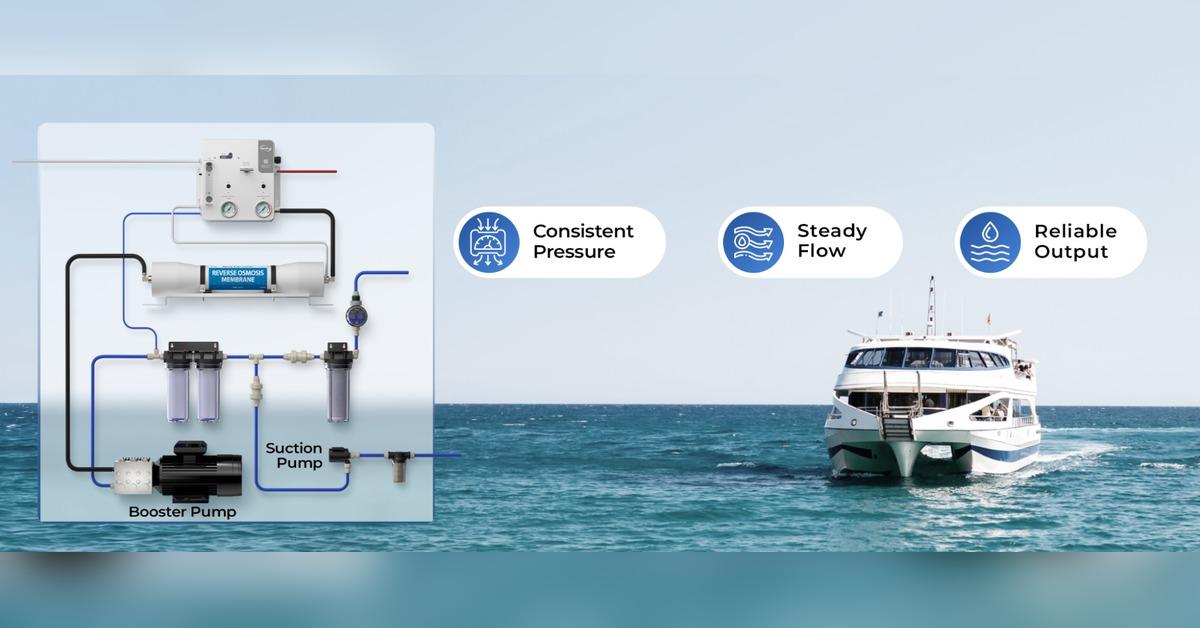
At the technical core of the iSpring BRO900 is a rigorous, multi-tiered purification process designed to handle the harshest marine environments and deliver water that meets or exceeds international drinking water standards. The system utilizes a sophisticated 5-stage filtration architecture, with each sequential tier engineered to eliminate specific categories of contaminants.
The purification journey begins externally and internally through a heavy-duty stainless-steel mesh filter, which captures large suspended debris, marine algae, and macroscopic particulates. Following this initial physical barrier, the water passes through a 20-micron polypropylene (PP) filter, which strips out finer sand, silt, and rust particles. The third stage employs a tighter 5-micron PP filter, ensuring that microscopic suspended solids are entirely eradicated before the water approaches the high-pressure components.
Once pre-filtered, the water encounters the crown jewel of the system: a specialized industrial-grade reverse osmosis membrane. Operating under intense pressure, this semi-permeable membrane serves as a formidable barrier against dissolved salts, heavy metals, industrial pollutants, and emerging chemical contaminants such as per- and polyfluoroalkyl substances (PFAS). According to preliminary performance data released by the manufacturer, the RO membrane is capable of eliminating up to 99% of dissolved salts and impurities.
To ensure absolute microbiological safety, the final phase of purification incorporates a built-in LED ultraviolet (UV) module housed directly within the control box. While the RO membrane effectively blocks microscopic pathogens, the secondary UV treatment provides a crucial redundancy, neutralizing lingering bacteria, viruses, and residual microorganisms. The resulting purified water is clean, crisp, and completely safe for direct consumption, food preparation, and hot beverage brewing.
Engineering Resilience: Pumps, Pressure, and Performance
Keeping a continuous, stable volume of seawater flowing into a high-pressure desalination system while underway is a notoriously complex engineering feat. As a vessel navigates through changing sea states, waves, and varying speeds, the hull’s draft fluctuates wildly, often causing traditional intake pumps to cavitate or lose prime entirely.
To counteract this hydrodynamic challenge, iSpring equipped the BRO900 with a dual-pump architecture comprising a dedicated suction pump and a high-pressure booster pump. The primary suction pump is engineered to draw a robust, uninterrupted volume of seawater into the system, ensuring a stable baseline flow even when the vessel is pitching and rolling in choppy coastal waters.

Once the intake flow is stabilized, the high-pressure booster pump elevates the water pressure to a standard operating range of 600 to 900 psi (with an optimal baseline of 800 psi). This immense pressure is necessary to overcome the natural osmotic pressure of seawater, forcing water molecules through the tightly wound reverse osmosis membrane while leaving concentrated brine behind to be discharged overboard.
This robust hydraulic setup enables the BRO900 to generate up to 900 gallons of pure, refreshing water per day. Such high-capacity output effortlessly supports the multifaceted operational demands of a modern vessel, transforming daily chores—such as cooking, laundry, equipment cleaning, and personal hygiene—from anxious rationing exercises into effortless routines.
Intelligent Control and Automated Maintenance
Operating complex machinery in the middle of the ocean requires intuitive interfaces that minimize human error and provide clear diagnostic feedback. The iSpring BRO900 features an advanced, centralized smart control box designed to give operators complete command over the desalination process with minimal training.
The control panel features a real-time Total Dissolved Solids (TDS) digital display, providing instant verification of water purity. It is complemented by an integrated RO flow meter and dual pressure gauges that continuously track intake pressure and operational RO pressure. This allows the crew to monitor system health and filtration efficiency at a glance. Furthermore, dedicated suction and RO pressure regulators give operators the flexibility to make precise manual adjustments tailored to varying sea temperatures, ambient salinities, and unique coastal conditions, while independent switches for the suction and booster pumps offer enhanced operational control.
One of the most persistent operational hurdles in marine desalination is membrane fouling. Over time, salt crystals, organic biofilms, and mineral scaling inevitably accumulate on the surface of the RO membrane, degrading filtration efficiency and drastically shortening the lifespan of the component. To combat this, the BRO900 incorporates an intelligent, automated membrane flushing system.
The automated flusher periodically bathes the RO membrane in clean, filtered water, actively washing away accumulated salts and biological residues before they can harden into stubborn scale. Users can easily program the system to run automatic flush cycles on a weekly schedule tailored to their usage patterns, adjusting the duration of the rinse with a few simple inputs. For situations requiring immediate intervention—such as preparing a vessel for extended dockside storage—the flushing cycle can also be initiated manually on demand.
Corrosion Resistance and Structural Durability
Marine environments are uniquely hostile to mechanical equipment. The combination of high ambient salinity, airborne salt spray, persistent humidity, and extreme temperature fluctuations creates an accelerated corrosion rate that can reduce standard industrial metals to rust in a matter of months.
To ensure long-term durability and operational longevity, every structural and internal component of the iSpring BRO900 has been selected for its superior resistance to marine corrosion. The system utilizes marine-grade alloys, high-impact engineering plastics, and protective enclosures designed to shield sensitive electronics and pumps from the corrosive sea air.
Additionally, recognizing that vessels frequently encounter violent storms, sudden swells, and violent vibrations during navigation, iSpring built the BRO900 with a structurally reinforced, compact modular chassis. This ruggedized construction dampens mechanical shock and secures internal plumbing, ensuring that the system continues to function seamlessly despite the punishing physical dynamics of life on the water.
Timeline, Launch Details, and Special Introductory Offers
The commercial rollout of the iSpring BRO900 has been structured to give maritime distributors, boat builders, and private vessel owners ample time to evaluate the system’s specifications ahead of the peak commissioning season.
- October 20, 2026: Official global launch of the iSpring BRO900 onboard seawater desalination system, marking iSpring Water Systems’ formal entry into the commercial and recreational marine water treatment sector.
- October 20 – November 20, 2026: A limited-time global introductory promotion period during which early adopters and maritime enthusiasts can purchase the BRO900 with a $1,000 direct manufacturer discount.
- Post-Launch Phase: Ongoing rollout of specialized dealer support, technical documentation, and customer service training to assist with custom marine retrofits and new vessel integrations.
Industry analysts note that the introduction of the BRO900 arrives at a time of surging interest in off-grid maritime exploration, recreational boating, and sustainable long-range cruising. By offering a high-capacity, intelligently automated, and corrosion-resistant desalination system at a competitive price point, iSpring is poised to capture significant market share in a sector historically dominated by legacy marine-specific brands. As the official launch date approaches, marine operators seeking to expand their cruising range and eliminate the logistical burden of freshwater storage are increasingly turning their attention to iSpring’s bold new venture into blue-water filtration.
Related posts: