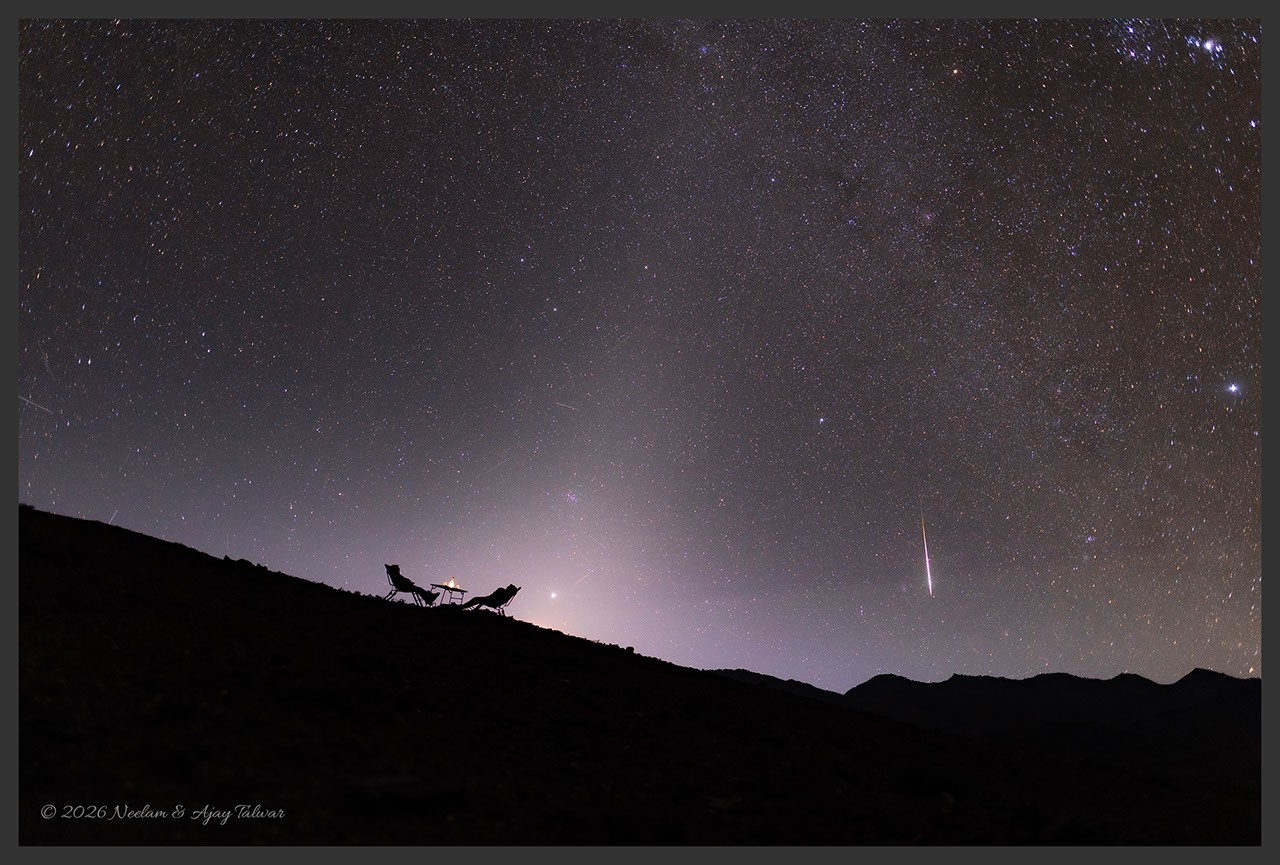
Gazing into the night sky from one of the highest astronomical observation points on Earth reveals a celestial phenomenon that has puzzled scientists and inspired stargazers for centuries: the zodiacal light. Often referred to as a "false dawn," this ethereal, cone-shaped glow of white light stretches up from the horizon along the path of the zodiac. Recently highlighted by NASA’s prestigious Astronomy Picture of the Day (APOD) initiative, a breathtaking capture from the Hanle Dark Sky Reserve in Ladakh, India, has once again brought this cosmic phenomenon into the global spotlight, while simultaneously underlining groundbreaking theories regarding its origin.
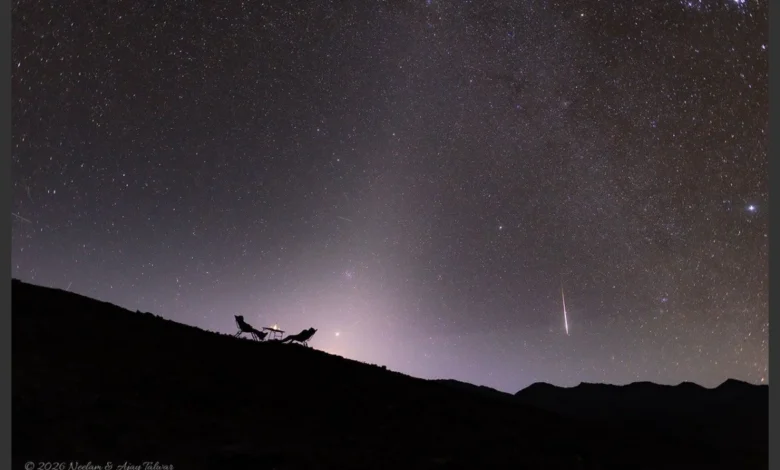
The featured photograph, captured during a September star party at an elevation of approximately 4,500 meters (14,764 feet), presents a pristine view of the night sky free from the veils of modern light pollution. In the frame, two stargazers are silhouetted against a backdrop of cosmic wonders, looking up as meteors streak across the stratosphere. The composition not only showcases the faint, triangular pillar of the zodiacal light rising in the east, but also expertly points out prominent celestial landmarks, including the brilliant planet Jupiter, the Beehive Cluster (M44), and a distinctively yellowish Mars positioned near the center of the frame.
This stunning visual record serves as a window into both the beauty of high-altitude astrophotography and the evolving scientific understanding of our solar system’s interplanetary dust environment.
Understanding the False Dawn: What is Zodiacal Light?
Zodiacal light is a faint, diffuse glow of sunlight scattered by interplanetary dust particles concentrated in the plane of the solar system, known as the ecliptic. Because this plane aligns with the zodiac constellations through which the sun, moon, and planets appear to travel, the resulting illumination is named accordingly.
To observers on Earth, the phenomenon is best viewed after evening twilight in the spring or before morning twilight in the autumn, when the ecliptic intersects the horizon at a steep angle. In areas devoid of artificial light, the zodiacal glow can appear remarkably bright—often mistaken by casual observers for the early light of dawn, hence the moniker "false dawn."
For generations, astronomers debated the exact mechanics and origins of the particulate matter responsible for back-scattering this sunlight. While cometary debris and asteroidal collisions were long considered the primary contributors, recent space exploration has dramatically shifted the paradigm.
The Martian Connection: Solving an Interplanetary Mystery
For years, conventional scientific consensus pointed toward active comets and fragments from the asteroid belt as the principal sources of the dust cloud fueling the zodiacal light. However, data returned by NASA’s Juno spacecraft during its cruise phase to Jupiter shattered long-held assumptions and provided a compelling new narrative.
Serendipitous detections by Juno’s star tracker cameras—originally designed to navigate the spacecraft by mapping star fields—revealed countless microscopic impacts from high-velocity dust particles. Detailed analysis of these impacts published in planetary science literature indicated that a massive cloud of interplanetary dust permeates the inner solar system, and crucially, that Mars is the primary generator of this material.
According to these findings, high-velocity meteoroids strike the surface of the Red Planet, kicking up fine dust into the thin Martian atmosphere. Over millions of years, solar radiation pressure and gravitational interactions sweep this material into interplanetary space, distributing it along the orbital plane. This Martian dust torus acts as the primary scattering medium for sunlight, effectively creating the luminous zodiacal pyramids witnessed by astrophotographers on Earth.
Hanle Dark Sky Reserve: A Haven for High-Altitude Astronomy
The setting for NASA’s featured photograph is as remarkable as the celestial event itself. Situated in the cold, arid desert of the Changthang region in Ladakh, India, the Hanle Dark Sky Reserve spans an area centered around the Indian Astronomical Observatory (IAO). Operated by the Indian Institute of Astrophysics, the site is one of the highest optical observing stations in the world.
At 4,500 meters above sea level, the reserve sits above a significant portion of Earth’s dense atmosphere, minimizing atmospheric turbulence and light diffusion. Combined with extremely low annual precipitation and cloud cover, Hanle offers pristine viewing conditions that rival famed astronomical outposts in Chile’s Atacama Desert and Hawaii’s Mauna Kea.
In recent years, local authorities and scientific institutions have worked diligently to protect the region from light pollution, establishing India’s first dark sky reserve. This designation not only safeguards professional scientific research but also fosters astrophotography and astro-tourism, drawing hardy enthusiasts from around the globe who brave the extreme altitude and sub-zero temperatures to witness the unblemished cosmos.
The Evolution of NASA’s Astronomy Picture of the Day
Beyond the scientific and aesthetic merits of the featured image, the publication marks a transitional milestone for the APOD platform itself. Established in 1995 by professional astronomers Robert Nemiroff and Jerry Bonnell, APOD has operated continuously for nearly three decades, serving as one of NASA’s most enduring and widely accessed public outreach tools. Each day, the platform pairs a striking astronomical photograph with a concise, accessible explanation written by a professional astronomer.
As part of ongoing modernization efforts by the agency, NASA has transitioned the main hosting infrastructure of APOD from its long-standing domain (apod.nasa.gov) to its centralized science portal (science.nasa.gov/apod). This migration ensures that the treasure trove of daily cosmic imagery remains securely integrated within NASA’s broader digital ecosystem, offering enhanced accessibility, improved mobile responsiveness, and long-term archival stability for educators, students, and space enthusiasts worldwide.
Broader Implications for Planetary Science and Stargazing
The convergence of high-altitude photography, cutting-edge planetary research, and institutional web migration highlights the dynamic nature of modern astronomy. Images like the zodiacal light capture over the Himalayas bridge the gap between complex, deep-space data collected by interplanetary probes like Juno and the tangible, human experience of looking up at the night sky.
As researchers continue to analyze dust dynamics within the inner solar system, observations from dark sky reserves will play an increasingly vital role in ground-truthing space-based measurements. Simultaneously, public outreach initiatives like APOD continue to inspire the next generation of scientists, ensuring that humanity maintains its deep, inquisitive connection to the universe. Whether viewed through the lens of a sophisticated space probe measuring microscopic particle impacts or by two travelers seated beneath the majestic peaks of Ladakh, the cosmos continues to reveal its intricate and interconnected mechanisms.