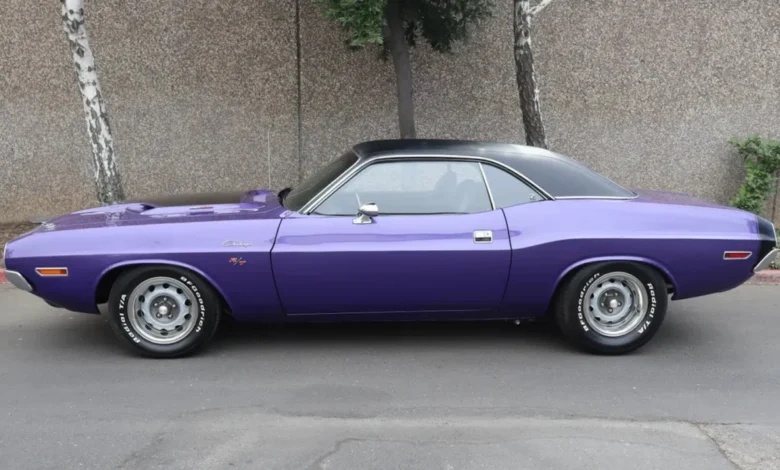
The automotive collector market has witnessed a surge in interest regarding Mopar’s iconic E-Body vehicles, a trend underscored by the recent listing of a 1970 Dodge Challenger R/T finished in the legendary “Plum Crazy” high-impact exterior paint. Currently offered through Ryle’s Rides in Sacramento, California, the vehicle is priced at $69,995. This listing arrives on the heels of several high-profile sales of similar muscle-era vehicles, reinforcing the enduring valuation of Chrysler Corporation’s most aggressive aesthetic offerings from the turn of the 1970s.
Historical Context and the E-Body Platform
To understand the significance of this specific Challenger, one must consider the historical landscape of the late 1960s. By 1970, the "Pony Car" segment—pioneered by the Ford Mustang and refined by the Chevrolet Camaro—had reached a fever pitch. Dodge, having previously focused on larger B-Body vehicles like the Charger and Coronet, entered the fray with the Challenger. Sharing the E-Body platform with the Plymouth Barracuda, the Challenger was designed to bridge the gap between the compact sports car and the mid-sized muscle car.
The 1970 model year represented the debut of this platform. It was a late arrival to the market, but it made an immediate impact due to its sophisticated styling and the availability of nearly every engine in the Chrysler performance catalog, ranging from the slant-six to the legendary 426 Hemi. The R/T (Road/Track) trim was positioned as the top-tier performance variant, designed for the buyer who demanded both acceleration and a distinct, aggressive visual profile.
Mechanical Specifications and Modifications
The Challenger currently listed in Sacramento presents an interesting case study in the evolution of collector vehicles. According to its original factory fender tag, this specific chassis was produced with a 383-cubic-inch Magnum V8 paired to a four-speed manual transmission. However, the vehicle has undergone a significant mechanical transition during its life.
The engine currently residing in the engine bay is a 1969-vintage 440-cubic-inch big-block V8. This substitution is a common practice among Mopar enthusiasts, as the 440 offers increased displacement and torque compared to the factory-issue 383. To support this increased power output, the vehicle has been outfitted with an aluminum intake manifold, a four-barrel carburetor, and polished chrome valve covers. Thermal management is handled by an upgraded aluminum radiator, a necessary modification for maintaining optimal operating temperatures during spirited driving or summer car shows.
The powertrain remains tethered to a four-speed manual gearbox, retaining the classic tactile experience of the era through the inclusion of a pistol-grip shifter—a signature element of high-performance Dodge vehicles of that period. The aesthetic package is completed by the classic black vinyl roof, a matte black center stripe on the hood, authentic R/T badging, and Rallye-style wheels wrapped in BFGoodrich Radial T/A tires. Inside, the cabin features period-correct bucket seats and a wood-rimmed steering wheel, maintaining the minimalist, driver-focused interior design language of 1970.
Chronology of the 1970 Dodge Challenger
The release of the Challenger was part of a broader corporate strategy by Chrysler to recapture market share in the youth-oriented segment.
- 1969: Initial development and testing of the E-Body platform reach completion.
- Fall 1969: The 1970 model year Dodge Challenger officially launches, marketed as a direct competitor to the Mercury Cougar and Pontiac Firebird.
- 1970: The model year sees the peak of the “High Impact” color palette, including Plum Crazy, Sublime, Go Mango, and Panther Pink, which were marketed to attract younger, style-conscious buyers.
- 1971–1974: The model undergoes minor styling tweaks, but increasingly stringent emissions regulations and rising insurance premiums lead to a gradual reduction in horsepower ratings.
- 1974: Production of the first-generation Challenger concludes.
- Modern Era: The Challenger nameplate was revived in 2008, and the vehicle has since become a staple of the modern Dodge lineup, with the final internal combustion models rolling off the assembly line in 2023.
Market Analysis: Is $70,000 Justified?
The asking price of $69,995 places this vehicle in a specific tier of the collector market. When analyzing the investment value, one must compare the historical pricing with modern economic indicators. In 1970, a base Challenger could be purchased for approximately $2,850, while the R/T variant commanded a premium of $3,266. Adjusted for inflation, these figures represent roughly $25,000 and $28,000 in 2024 currency.
While the price of $69,995 is significantly higher than the inflation-adjusted MSRP, it is important to contextualize the current automotive market. A brand-new 2027 Dodge Charger Scat Pack, which serves as the spiritual successor to these classic muscle cars, starts at approximately $50,000 before destination charges and dealer markups. When viewed through this lens, a meticulously maintained classic car with a period-correct 440 engine swap occupies a different niche than a modern mass-produced vehicle.
Furthermore, the 96,199 miles on the odometer suggest this is a vehicle that has been enjoyed on the road rather than hidden away in a climate-controlled vault. For collectors, "driver-quality" classics often hold a different value proposition than "trailer queens," as they allow for immediate enjoyment of the mechanical driving experience without the anxiety of risking a pristine, low-mileage investment.
Implications for the Collector Car Community
The availability of this vehicle reflects a broader trend in the collector car community: the commodification of nostalgia. As the generation that grew up with these vehicles begins to reach peak retirement age, demand for icons of the "Golden Age of Muscle" remains robust. Plum Crazy, in particular, is one of the most sought-after colors in the Mopar community, often commanding a premium over more conservative color palettes like black or silver.
Industry experts observe that while the market for certain vintage vehicles has softened due to higher interest rates and economic uncertainty, "blue-chip" muscle cars—those with desirable engine configurations and high-impact paint—remain resilient. The swap to a 440 V8, while technically a deviation from the factory-original build sheet, is generally viewed as an enhancement in the muscle car community. It adds utility and performance value that outweighs the loss of "numbers-matching" purity, provided the rest of the car remains structurally sound and cosmetically period-correct.
Conclusion
The listing of this 1970 Dodge Challenger R/T serves as a reminder of the unique intersection between automotive history and modern investment. Whether the vehicle will fetch the full asking price remains to be seen, but its presence on the market highlights the continued allure of the E-Body platform. With its combination of the iconic 440 big-block, the manual transmission, and the highly desirable Plum Crazy exterior, the car represents a quintessential piece of American automotive culture. As the industry transitions toward electric powertrains and software-defined vehicles, these mechanical, high-displacement machines are likely to retain their status as tangible artifacts of an era defined by raw power and distinct, unapologetic design. Potential buyers are advised to conduct a thorough pre-purchase inspection to verify the integrity of the chassis and the quality of the engine swap, ensuring that the vehicle’s mechanical history aligns with the seller’s disclosures.
Related posts: