Voyager 2’s Historic 1989 Neptune Flyby Captured in Rare Composite Image Highlighting the Ice Giant in Crescent Phase

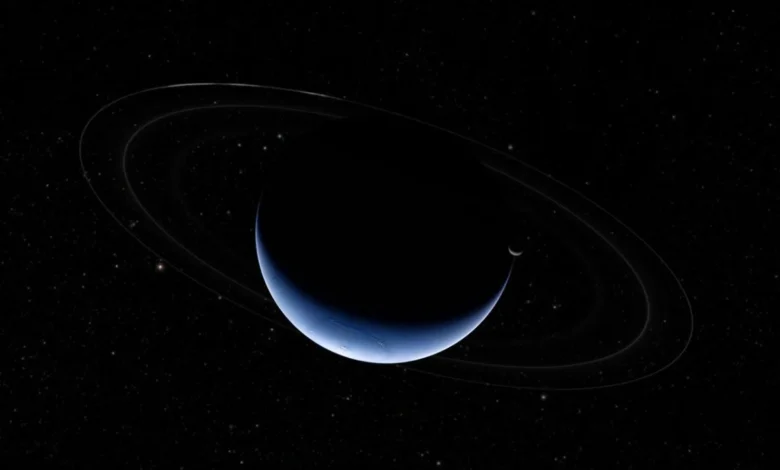
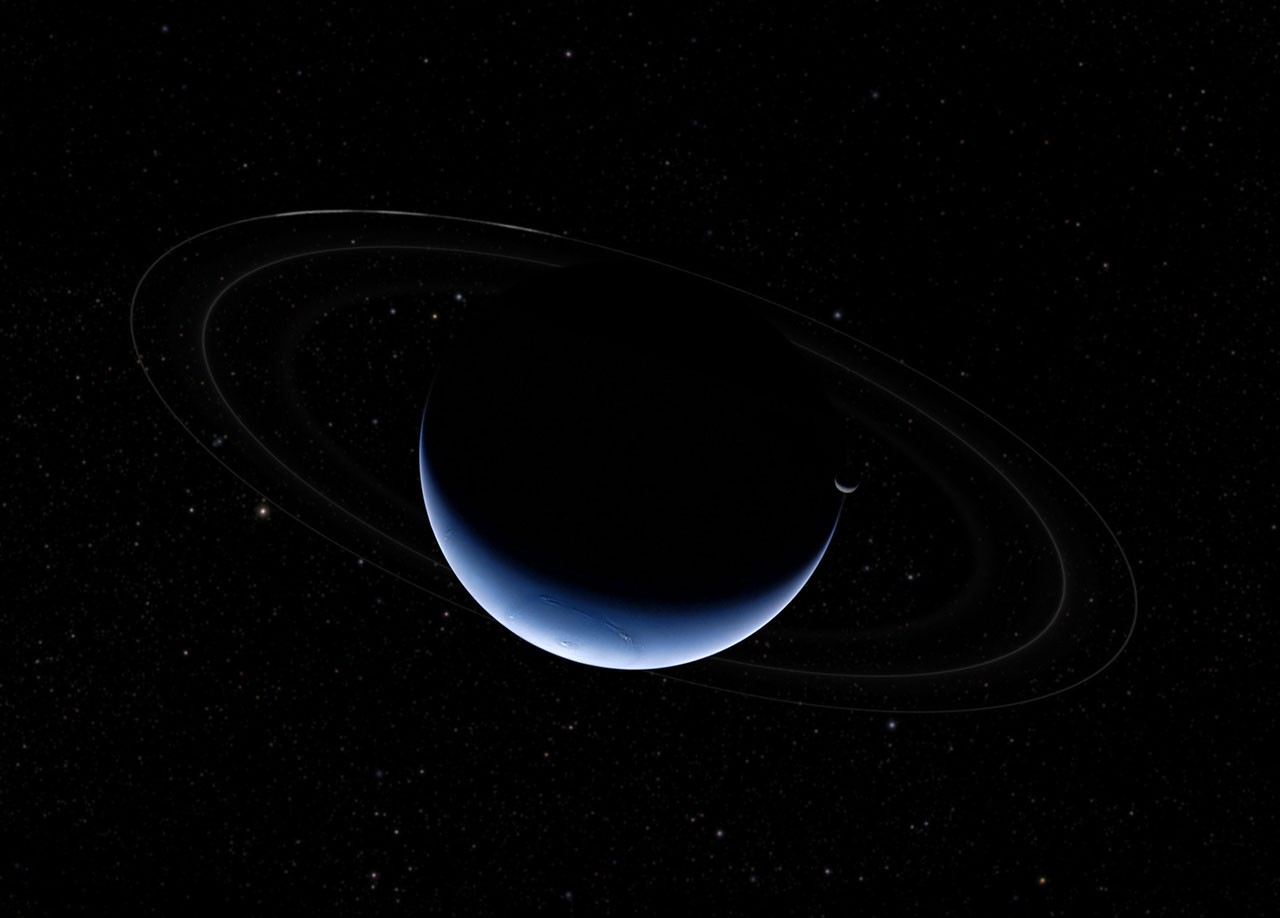
On August 25, 1989, humanity achieved a watershed moment in planetary exploration when the Voyager 2 spacecraft made its historic closest approach to Neptune, the outermost major planet in our solar system. As the sole human-made emissary to ever visit this distant ice giant, Voyager 2 fundamentally transformed our understanding of the outer solar system. Decades after that monumental encounter, NASA’s Astronomy Picture of今日 (APOD) featured a meticulously crafted, inspired composite image that brings this distant world back into sharp focus. Constructed from historical data recorded during the 1989 flyby and subsequent days, the scene depicts Neptune, its largest moon Triton, and its delicate ring system viewed from an interplanetary perspective looking back toward the Sun, presenting both celestial bodies as thin, sunlit crescents.
The awe-inspiring visualization serves as a poignant reminder of the incredible engineering feats of the late 20th century. While the spacecraft itself has long since crossed the heliopause into interstellar space, the wealth of scientific data it transmitted back to Earth continues to yield new perspectives. This detailed examination explores the background of the Voyager mission, the specific dynamics of the 1989 Neptune encounter, the unique composition of the ice giant, and the enduring legacy of humanity’s most ambitious journey into the deep cosmos.
Main Facts of the Voyager 2 Neptune Encounter
The Voyager 2 spacecraft’s encounter with Neptune represented the final planetary flyby of the grand tour that also took in Jupiter, Saturn, and Uranus. Passing approximately 4,950 kilometers (3,080 miles) above Neptune’s north pole at 03:56 UTC on August 25, 1989, the spacecraft was subjected to extreme conditions at the edges of the planetary system.
At a distance of roughly 4.5 billion kilometers from Earth, radio signals traveling at the speed of light took over four hours to reach mission control at the Jet Propulsion Laboratory (JPL) in Pasadena, California. Despite the dim sunlight—operating at roughly 0.1% of the solar intensity experienced on Earth—Voyager 2’s narrow-angle camera and remote sensing instruments managed to capture stunning high-resolution details of the planet’s dynamic atmosphere, complex ring arcs, and icy satellites.
The composite image highlights several key features discovered or confirmed during the flyby:
- Atmospheric Dynamics: Distinct cirrus-type clouds and a dark band circling the south polar region, accompanied by a cloudy vortex directly above the south pole.
- Triton, the Iced Moon: Neptune’s largest moon, Triton, is shown as a sunlit crescent, reflecting the unique back-lit geometry of Voyager’s outbound trajectory.
- Faint Ring System: While Voyager confirmed the existence of Neptune’s ring system and discovered three bright ring arcs, the faintest segments and background starfields in the composite are expertly modeled using contemporary sky survey data centered on the constellation Camelopardalis.
Chronology of the Voyager 2 Mission
To fully appreciate the significance of the 1989 Neptune encounter, it is essential to trace the timeline of the Voyager program, which capitalized on a rare planetary alignment that occurs only once every 176 years.
The Launch Era (1977)
- August 20, 1977: Voyager 2 is launched from Cape Canaveral, Florida, aboard a Titan IIIE-Centaur rocket. Interestingly, it was launched before its twin, Voyager 1, on a slightly different trajectory designed to enable encounters with all four outer gas and ice giants.
- September 5, 1977: Voyager 1 is successfully launched on a faster trajectory, eventually overtaking Voyager 2 and prioritizing a close flyby of Saturn’s moon Titan.
The Outer Planet Flybys (1979–1986)
- July 9, 1979: Voyager 2 makes its closest approach to Jupiter, returning unprecedented images of the Jovian atmosphere, the Great Red Spot, and active volcanism on the moon Io.
- August 25, 1981: The spacecraft encounters Saturn, capturing detailed data on the complex structure of Saturn’s rings and the thick atmosphere of Titan.
- January 24, 1986: Voyager 2 reaches Uranus, becoming the first and only spacecraft to study the ice giant. It discovers 10 new moons, analyzes the planet’s extreme 98-degree axial tilt, and maps its unusual magnetic field.
The Neptune Milestone (1989)
- June–August 1989: As Voyager 2 approaches Neptune, scientists observe distinct dark spots in the atmosphere and track high-speed winds.
- August 25, 1989: The spacecraft achieves its closest approach to Neptune, followed later that same day by a close flyby of Triton, revealing nitrogen geysers and a remarkably young, crater-sparse surface.
- September 1989: The formal primary planetary encounter phase concludes, and the mission transitions into the Voyager Interstellar Mission.
Into Interstellar Space (2018–Present)
- December 10, 2018: NASA officially confirms that Voyager 2 has crossed the heliopause—the boundary where the solar wind is pressure-dominated by the interstellar medium—entering interstellar space at a distance of over 118 astronomical units from the Sun.
- 2026 and Beyond: Operating for nearly half a century, both Voyager 1 and Voyager 2 continue to communicate with NASA’s Deep Space Network, returning invaluable baseline measurements of the cosmic environment far beyond the planets.
Supporting Data and Technical Specifications
The longevity and success of the Voyager mission rely on robust engineering and careful power management. Operating in the freezing reaches of the outer solar system rendered traditional solar panels useless; thus, the spacecraft were equipped with Radioisotope Thermoelectric Generators (RTGs).
| Parameter | Voyager 2 Details |
|---|---|
| Launch Date | August 20, 1977 |
| Neptune Closest Approach | August 25, 1989 |
| Distance at Neptune Flyby | ~4.5 billion km from Earth |
| Power Source | Plutonium-238 Radioisotope Thermoelectric Generators (RTGs) |
| Current Status | Operating in interstellar space (approx. 2026) |
| Communication Delay | Over 4 hours one-way to Earth |
The imaging system on Voyager 2 utilized two television-type cameras equipped with a filter wheel containing various color filters. Because Neptune receives such low light levels, exposures had to be long, requiring sophisticated image motion compensation mechanisms to prevent blurring as the spacecraft sped past the planet at tens of thousands of kilometers per hour.
Official Responses and Scientific Reflections
Upon the completion of the Neptune flyby in 1989, mission scientists and NASA leadership hailed the event as the culmination of the golden age of planetary reconnaissance.
Dr. Edward Stone, the long-serving project scientist for the Voyager mission based at the California Institute of Technology, frequently emphasized the profound shift in perspective provided by the flyby. In historical mission briefings, researchers noted that Neptune was no longer viewed merely as a faint, blurry dot in ground-based telescopes, but as a vibrant, dynamic world with active weather patterns, auroras, and a complex satellite system.
Planetary geologists were particularly astounded by Triton. The data indicated that the moon possessed an internal heat source capable of driving geysers of nitrogen gas and dust several kilometers high into its thin atmosphere. This discovery challenged prevailing assumptions that smaller moons in the outer solar system were geologically inert bodies.
Astrophysicists also gained vital insights into planetary magnetic fields. Voyager 2 discovered that Neptune’s magnetic field is tilted sharply relative to its rotational axis and offset significantly from the planet’s center, a bizarre configuration similar to that found at Uranus, prompting ongoing theoretical research into the internal dynamos of ice giant planets.
Broader Impact and Implications for Future Exploration
The legacy of the Voyager 2 Neptune flyby extends far beyond the historical textbooks. For decades, the data gathered during those few frantic weeks in August 1989 remained our primary source of knowledge regarding ice giant planets—a class of celestial body now known to be exceedingly common around other stars in our galaxy.
In the contemporary era of exoplanet discovery, astronomers frequently find Neptune-sized planets orbiting distant stars. Understanding the atmospheric composition, internal structure, and ring dynamics of our solar system’s two ice giants (Uranus and Neptune) serves as a critical baseline for interpreting observations from advanced space telescopes like the James Webb Space Telescope (JWST).
Furthermore, the enduring public fascination with archival imagery—such as the crescent Neptune composite featured by NASA’s APOD—demonstrates the cultural and educational power of space exploration. These visuals inspire subsequent generations of scientists, engineers, and dreamers to push the boundaries of technology.
As Voyager 2 continues its silent, solitary voyage through the interstellar void, it carries not only scientific instruments but also the Golden Record—a phonograph record containing sounds and images selected to portray the diversity of life and culture on Earth. The composite image of a sunlit crescent Neptune stands as a testament to humanity’s reach, capturing a fleeting moment when our robotic emissary bridged the vast gulf of space to reveal the hidden beauty of the farthest ice giant.