San Marino Officially Becomes the 76th Signatory to the Artemis Accords During Historic Ceremony in Rimini


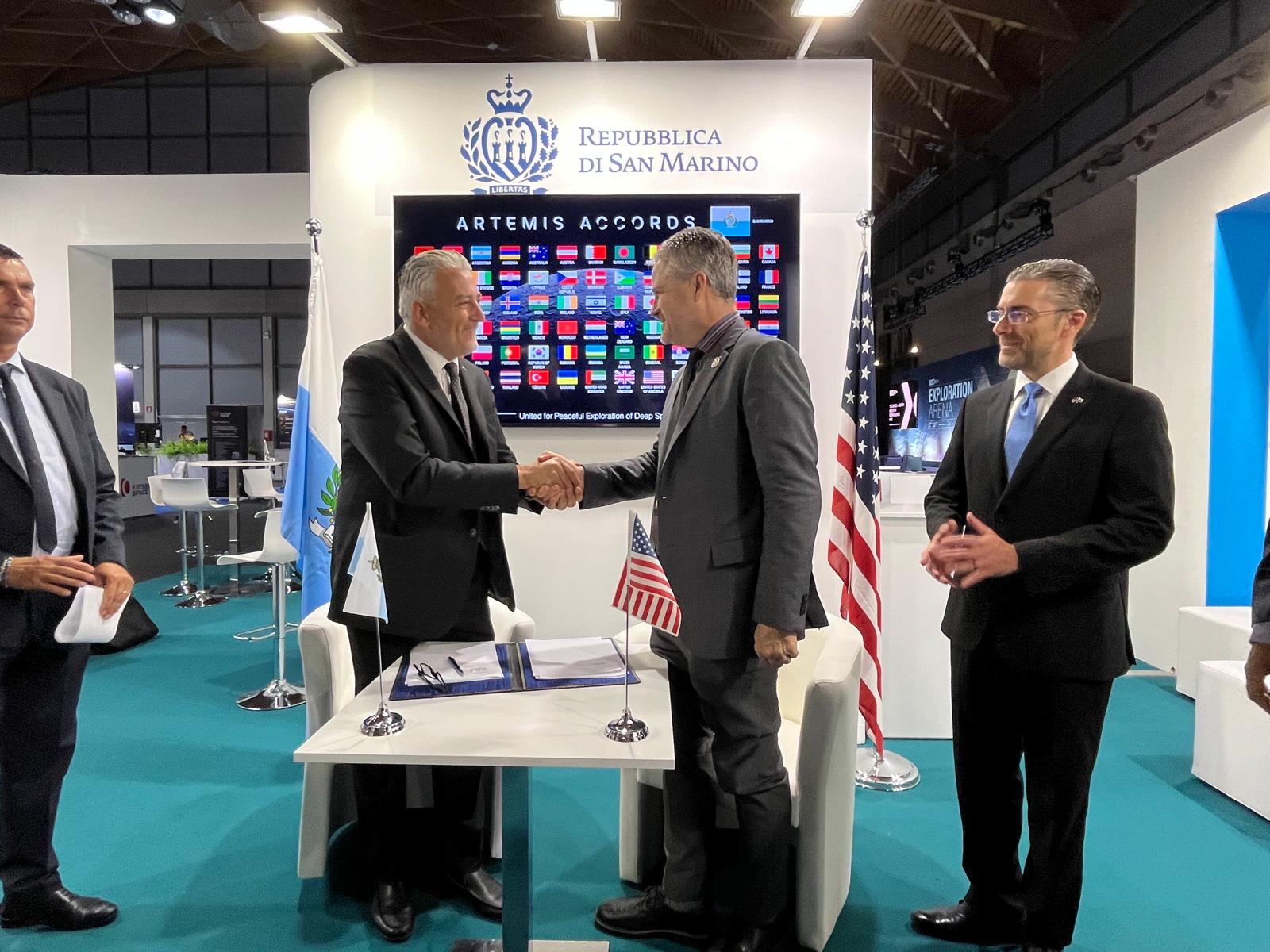
The Republic of San Marino has officially entered a new frontier of international diplomacy and space exploration by becoming the 76th nation to sign the Artemis Accords. The landmark signing ceremony took place on Friday in the neighboring Italian city of Rimini, drawing key dignitaries, aerospace officials, and diplomats from both the United States and San Marino. The event marks another milestone in the rapid global expansion of the Artemis Accords, a U.S.-led framework designed to guide civil space exploration and foster cooperative behavior in lunar orbit, on the Moon, and eventually on Mars and other celestial bodies.
The ceremony was attended by high-ranking officials, including NASA Deputy Administrator Matt Anderson, Gregory Mann, who serves as the NASA Europe representative, and Joseph Tordella, the U.S. Consul General in Florence. Representing the Republic of San Marino was the country’s Minister of Industry and Technological Research, Rossano Fabbri, who formally penned the signature binding the European enclave to the international space principles.
With this addition, San Marino joins a growing and diverse coalition of nations ranging from traditional spacefaring powers to emerging economies, all of whom have pledged adherence to a framework prioritizing safety, transparency, peaceful scientific collaboration, and the sustainable use of outer space.
Background and Context of the Artemis Accords
The Artemis Accords were established in October 2020 by NASA and the U.S. Department of State, working in partnership with seven founding member nations: Australia, Canada, Japan, Luxembourg, the United Arab Emirates, the United Kingdom, and the United States. The framework was conceived as an answer to the rapidly accelerating commercial and governmental interest in lunar exploration, resource utilization, and deep space operations.
As humanity prepares to return to the Moon for the first time in over half a century under NASA’s Artemis program, the international community recognized an urgent need for a shared set of behavioral guidelines. While the foundational Outer Space Treaty of 1967 remains the cornerstone of international space law—banning weapons of mass destruction in orbit and prohibiting sovereign claims of celestial territory—it left many practical, day-to-day operational questions unanswered.
The Artemis Accords build directly upon the Outer Space Treaty by introducing practical, non-binding principles designed to enhance governance and predictability in space. Key pillars of the Accords include the peaceful purposes of exploration, transparency to avoid conflicts or misunderstandings, the interoperability of systems, emergency assistance to distressed personnel, the public release of scientific data, the preservation of outer space heritage, the extraction and utilization of space resources in compliance with international law, the mitigation of orbital debris, and the deconfliction of space activities through designated safety zones.
Chronology of Expansion: From 7 to 76 Signatories
The journey from a coalition of eight founding nations to a massive global network of 76 signatories highlights how rapidly international priorities have shifted toward cooperative space exploration.
In the immediate aftermath of the Accords’ launch in late 2020 and throughout 2021, early adopters were primarily close allies of the United States, including European nations like Italy and Ukraine, as well as Indo-Pacific partners. However, the coalition quickly gained momentum across Latin America, Africa, and smaller European states.
By 2023 and 2024, the signing rate accelerated significantly as nations recognized that participation in the Artemis ecosystem offered unprecedented opportunities for scientific exchange, educational development, and technical collaboration. Smaller nations, in particular, found value in the Accords because they guarantee that scientific data gathered under Artemis missions remains openly accessible to the global research community.
The inclusion of San Marino in late 2026 underscores that geographic size or the absence of a domestic heavy-launch infrastructure is no longer a barrier to active participation in space exploration. Through targeted contributions such as CubeSats, scientific payloads, software development, and specialized technology demonstrations, nations of all sizes can carve out a meaningful role in the modern space economy.
Official Responses and Statements
During Friday’s ceremony in Rimini, leaders from both participating delegations emphasized the long-term value of the partnership and the broader vision for humanity’s return to the lunar surface.
"San Marino joins a growing coalition of like-minded nations committed to the peaceful, transparent, and responsible exploration of space," declared NASA Deputy Administrator Matt Anderson during his keynote remarks. "President Trump has directed NASA to build a Moon Base and establish an enduring presence on the lunar surface. As we do, we are putting the principles of the Accords into practice. NASA has invited every Artemis Accords signatory to participate in our return to the Moon through scientific payloads, technology demonstrations, CubeSats, and other capabilities. San Marino is already looking toward that future."
Anderson’s comments highlighted the practical dimension of the Accords. Rather than acting merely as a diplomatic gesture, signing the framework opens concrete pathways for academic institutions, private enterprises, and government agencies within signatory nations to collaborate directly with NASA on hardware, software, and research initiatives.
Minister of Industry and Technological Research Rossano Fabbri echoed these sentiments, expressing deep pride in his nation’s new status within the global aerospace community.
"We are pleased and honored that the Republic of San Marino has been welcomed as the 76th signatory state of the Artemis Accords," Fabbri stated following the signing. "We fully share the principles and values expressed in the Artemis Accords, and we are convinced that the signatory states united under the Accords will make a tangible contribution to promoting international cooperation in space and ensuring the use of space for peaceful purposes."
Fabbri noted that the agreement aligns with San Marino’s broader domestic goals of encouraging high-tech innovation, fostering international scientific partnerships, and preparing its younger generations for careers in science, technology, engineering, and mathematics (STEM).
Broader Impact and Strategic Implications
The addition of San Marino as the 76th signatory carries several layers of strategic and operational significance for the global space community.
First, it reinforces the diplomatic momentum of multilateral norms in an era where strategic competition on Earth risks spilling over into orbit. By voluntarily binding themselves to transparency, data sharing, and safety protocols, nations create a predictable operational environment that reduces the likelihood of miscalculation or conflict in cis-lunar space.
Second, the expanding coalition provides a vital counterweight to alternative visions of space governance proposed by rival spacefaring nations. By building an expansive, consensus-based coalition rooted in open science and the rule of law, the United States and its partners are effectively setting the global standard for how human civilization will operate off-world in the decades to come.
Finally, for San Marino itself, the agreement acts as a catalyst for economic and academic modernization. Even without a domestic spaceport, modern space programs rely heavily on distributed innovation networks. Small nations frequently excel in niche technological sectors, such as advanced materials, miniaturized electronics, data analytics, and specialized sensors. By joining the Artemis framework, Sammarinese research institutions and tech firms gain a recognized legal and diplomatic bridge to plug into the multi-billion-dollar global space supply chain.
As the Artemis program moves closer to establishing permanent infrastructure on the Moon, the coalition of 76 nations stands ready to write the next chapter of human history—one defined not by competition and division, but by shared scientific discovery and cooperation across the stars.