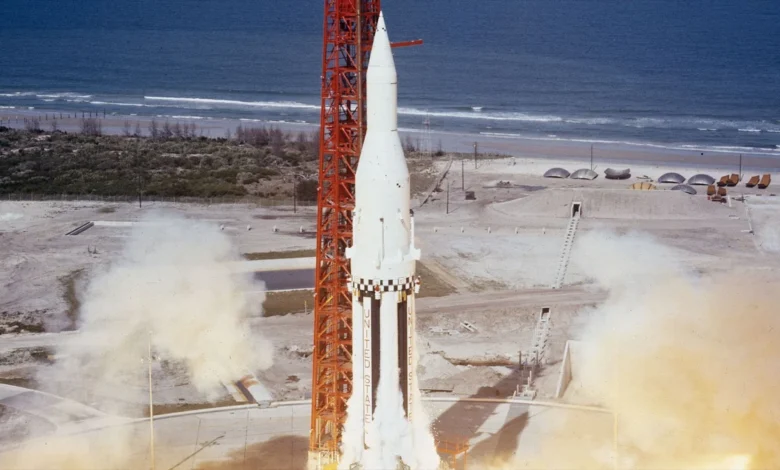
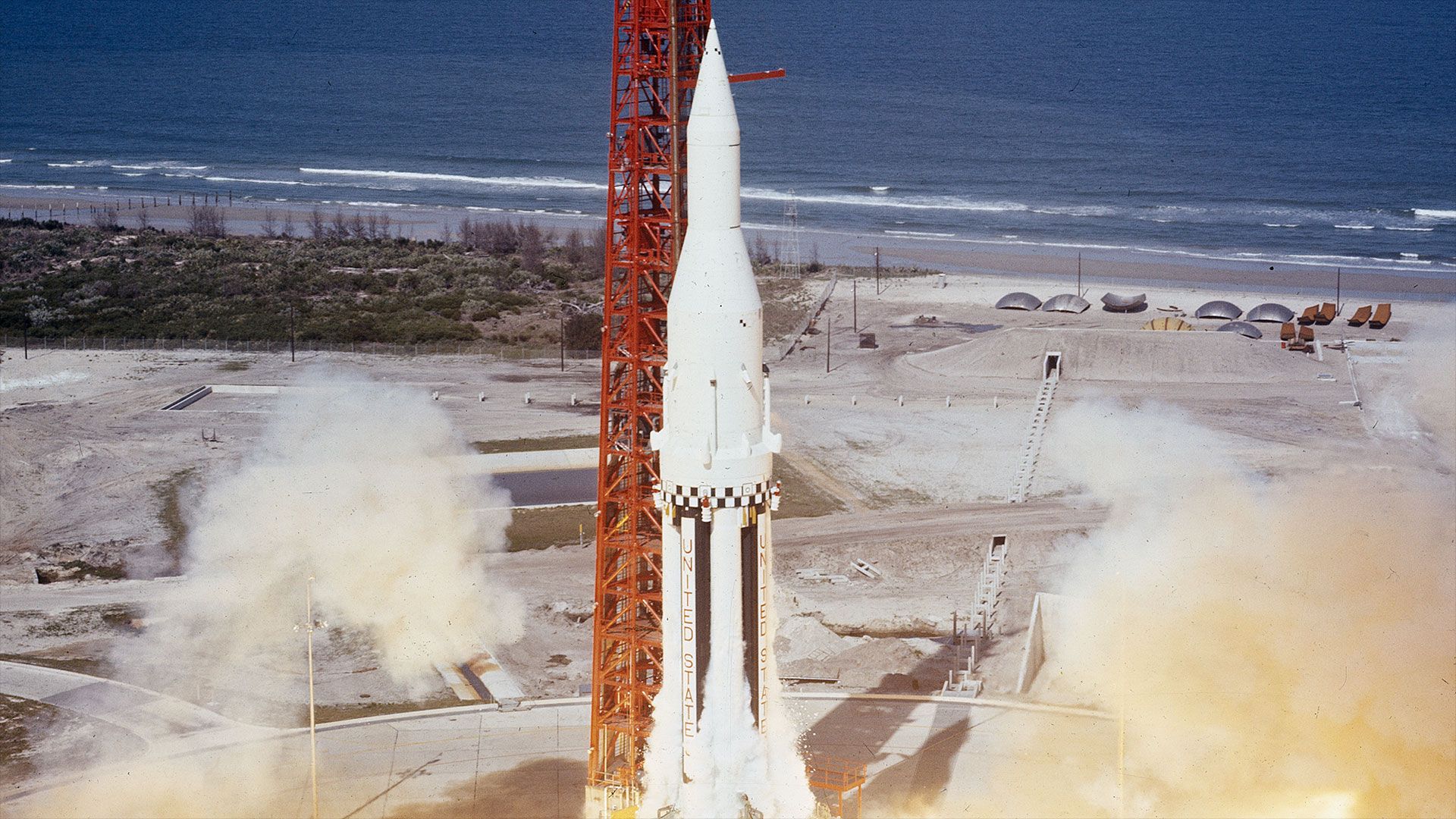
On November 9, 1967, the United States space program reached a pivotal threshold when the Saturn V rocket, a colossal feat of engineering, roared to life for the first time at the Kennedy Space Center in Florida. The Apollo 4 mission, an uncrewed flight test, served as the primary validation for the vehicle that would eventually carry humanity to the lunar surface. Standing at 363 feet tall—surpassing the height of the Statue of Liberty—the Saturn V was, at the time of its debut, the most powerful and complex launch vehicle ever constructed. Its successful maiden voyage not only demonstrated the viability of the three-stage rocket design but also restored a sense of national confidence in NASA following the devastating Apollo 1 tragedy earlier that same year.
The Engineering Marvel of the Apollo Era
The Saturn V was the culmination of years of intense research and development under the Marshall Space Flight Center, led by the renowned rocket pioneer Wernher von Braun. To achieve the velocity required to escape Earth’s gravity and propel a spacecraft to the moon, engineers designed a massive, three-stage system. The first stage, known as the S-IC, utilized five F-1 engines that burned a combination of kerosene and liquid oxygen, generating an astonishing 7.5 million pounds of thrust at liftoff. The second and third stages, fueled by liquid hydrogen and liquid oxygen, were designed to provide the necessary acceleration to reach orbital velocity and, eventually, trans-lunar injection.
The sheer scale of the vehicle necessitated the creation of entirely new infrastructure. Launch Complex 39 at the Kennedy Space Center was built specifically to accommodate the Saturn V’s immense size and weight. The facility included the Vehicle Assembly Building, one of the largest structures by volume in the world, where the rocket was stacked vertically before being transported to the pad on a massive crawler-transporter. When the rocket finally ignited on that November morning, the force of the exhaust was so immense that it created a shockwave capable of rattling buildings several miles away, showering the new launch center in debris and dust.
A Chronology of the Apollo 4 Mission
The Apollo 4 mission was meticulously planned to test the structural integrity and performance of the launch vehicle. Liftoff occurred at 7:00 a.m. EST. For the next eight hours and 36 minutes, the rocket performed flawlessly. The mission followed a rigorous profile:
- Liftoff and First Stage Burn: The S-IC stage performed as expected, clearing the tower and accelerating the stack through the dense lower atmosphere.
- Staging: The successful separation of the first stage and the ignition of the second stage marked a significant milestone, as this was the first time such an operation had been attempted with this vehicle configuration.
- Orbital Insertion: The third stage, or the S-IVB, placed the command module into a near-circular parking orbit.
- Re-entry Simulation: To ensure the Apollo command module could survive the intense heat of returning from the moon, the mission included a high-velocity re-entry test. The S-IVB reignited to push the spacecraft into a highly elliptical orbit, providing the necessary velocity for a simulated lunar return.
- Splashdown: The command module re-entered the atmosphere at high speed and splashed down in the Pacific Ocean, where it was successfully recovered, confirming that the heat shield technology was sufficient for human flight.
Contextualizing the Stakes: Recovering from Tragedy
The success of Apollo 4 arrived at a critical juncture for the National Aeronautics and Space Administration. Only nine months prior, the space agency had suffered a catastrophic blow on January 27, 1967. During a routine "plugs-out" test on the launch pad, a fire erupted inside the command module of Apollo 1, claiming the lives of astronauts Virgil "Gus" Grissom, Edward White, and Roger Chaffee. The incident led to a comprehensive investigation, a redesign of the command module’s hatch and interior, and a period of intense public scrutiny regarding the safety of the lunar program.
The success of the Saturn V flight on November 9 served as a critical psychological and technical reset. George Mueller, the then-Associate Administrator for Manned Space Flight, noted that the maiden voyage of the Saturn V significantly bolstered national confidence in the management of the Apollo program. It provided the tangible proof that the massive research and development effort was moving toward its goal, effectively transitioning the agency from a period of mourning and redesign to one of active pursuit of the moon landing.
Broader Implications and Legacy
The implications of the Apollo 4 flight extended far beyond the successful testing of a single rocket. By validating the Saturn V, NASA effectively secured the "heavy-lift" capability required for the entire Apollo program. The Saturn V would go on to launch every subsequent crewed mission to the moon, including the historic Apollo 11 landing in July 1969.

The successful launch also validated the operational procedures of the Kennedy Space Center. The facility, which had been designed to handle the logistical nightmare of preparing 363-foot-tall rockets, proved that it could manage the complexity of modern spaceflight. The performance of the rocket was nearly perfect, a fact that Wernher von Braun praised, highlighting that the vehicle had performed exactly as intended from the moment of ignition.
While the Saturn V remained the undisputed champion of heavy-lift rockets for decades, the landscape of space exploration has evolved. In recent years, SpaceX’s Starship megarocket has surpassed the Saturn V in terms of total thrust and launch capability. However, the legacy of the Saturn V remains etched in history as the vehicle that turned the theoretical possibility of lunar travel into a reality. The precision of the Apollo 4 mission—a "test flight" that operated with the reliability of a veteran system—remains a gold standard in aerospace engineering.
Analytical Perspective on NASA’s Apollo Strategy
From a management and engineering standpoint, the Apollo 4 mission serves as a masterclass in the "all-up" testing philosophy. Rather than testing each stage of the rocket individually over several years, NASA’s leadership, including Mueller and von Braun, opted to integrate the entire vehicle and test it in a single, high-stakes mission. This decision saved significant time and resources, allowing the agency to maintain the momentum required to meet the end-of-the-decade deadline set by President John F. Kennedy.
The success of this strategy meant that by late 1967, the most significant technical hurdle—the rocket itself—was largely cleared. This allowed engineers and astronauts to shift their focus to the Lunar Module and the complexities of deep-space navigation. The data collected during the 8-hour and 36-minute flight provided essential insights into vibration, thermal loads, and structural acoustics that would have been impossible to simulate accurately on the ground.

In the years following the retirement of the Saturn V, historians have frequently pointed to the November 1967 launch as the moment when the moon landing shifted from a visionary aspiration to a concrete, inevitable outcome. The roar of the Saturn V at Kennedy Space Center did more than just break the sound barrier; it broke the skepticism that had followed the Apollo 1 fire and set the trajectory for the most ambitious exploration campaign in human history. As the rocket vanished into the Florida sky, it carried with it the hopes of a nation, proving that the tools required for the greatest journey ever undertaken were finally in hand.