Beyond the CO2 obsession: Why decoupling methane from carbon targets is vital for limiting global warming


Methane is a powerful greenhouse gas and the second-largest contributor to global warming after carbon dioxide (CO2). While CO2 remains the primary focus of international climate policy, methane’s unique atmospheric profile—trapping heat with extreme efficiency over a relatively short lifespan—demands a distinct strategic approach. New research published in the journal Communications Earth & Environment argues that current climate models, which often bundle all emissions into a single "CO2 equivalent" metric, obscure the immediate benefits of rapid methane abatement and risk pushing global temperatures beyond critical thresholds.
The fundamental challenge in climate mitigation lies in the distinct physical properties of greenhouse gases. Carbon dioxide is the "long-term" driver of warming, persisting in the atmosphere for centuries. Methane, conversely, exerts a massive radiative forcing impact but fades after roughly two decades. By conflating these two, global climate models risk masking the specific opportunities for near-term temperature cooling. The scientific consensus, reinforced by the latest study from Weber et al. (2026), suggests that net-zero CO2 targets are insufficient on their own to keep the planet within the "well-below 2C" limit set by the Paris Agreement.
The Fallacy of the CO2 Equivalent Metric
For decades, the "CO2 equivalent" (CO2e) metric has served as the standard currency for international climate negotiations. It allows policymakers to calculate the warming potential of diverse gases—including methane, nitrous oxide, and hydrofluorocarbons—against the benchmark of carbon dioxide. However, this simplification is fraught with technical caveats.
Comparing methane to CO2 is often compared to comparing a meal of spaghetti to a chicken; while both provide calories, they are fundamentally different substances with different metabolic impacts. Because methane and CO2 have vastly different atmospheric lifetimes, any conversion is entirely dependent on the chosen time horizon. If a policy is designed for a 100-year window, methane’s impact is dampened; if it is designed for a 20-year window, its potency is magnified. Consequently, methane mitigation can be framed as an urgent global priority or, conversely, as a secondary concern, depending on the assumptions baked into the model.
Integrated Assessment Models (IAMs) typically generate emissions scenarios based on cost-effectiveness. By bundling all gases, these models make it nearly impossible to isolate the impact of methane-only interventions. Furthermore, these models assume that the global economy will follow the most efficient path to decarbonization, a premise that rarely holds true in the volatile landscape of real-world politics and industrial policy.
A New Framework for Decoupling
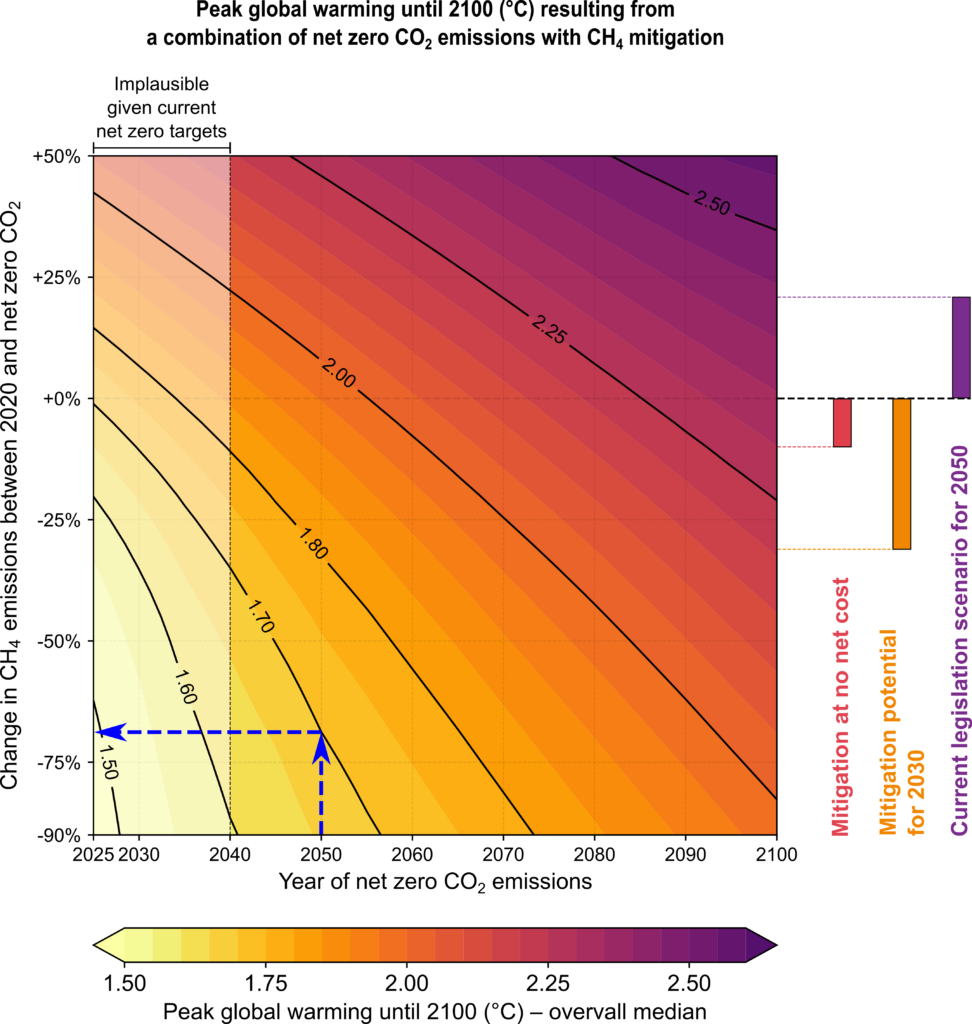
The study proposes a paradigm shift: rather than relying on a universal conversion metric, nations and corporations should set peak warming limits as their primary anchor. Once a temperature target—such as 1.7C or 1.8C—is established, the required rate of methane reduction becomes a mathematical necessity derived from existing net-zero CO2 pathways.
This approach treats methane and CO2 as independent variables. Under this model, the researchers analyzed various scenarios where organizations or nations pursue linear, steady emissions reductions. Their findings are stark: even under the most ambitious existing national net-zero targets, the failure to aggressively cut methane leads to peak warming that exceeds 1.85C. To successfully anchor warming at or below 1.7C, the study concludes that methane emissions must be slashed by at least 69% by 2050 relative to 2020 levels, assuming a 2050 net-zero CO2 target.
The Current Policy Landscape
Despite the clear climate benefits of methane reduction, the global policy framework remains underdeveloped. Only a handful of nations, including Japan, Mexico, and South Korea, have explicitly codified methane-specific mitigation targets within their broader climate strategies.

Current global trends are moving in the opposite direction. According to the 2025 Global Methane Status Report, methane emissions are projected to increase by approximately 20% by 2050 under current legislative trajectories. If this trend continues, even if the world achieves net-zero CO2 emissions by mid-century, the planet will likely still experience a peak warming event exceeding 2C. This outcome would effectively render the Paris Agreement’s "well-below 2C" commitment unattainable.
Chronology of Climate Targets and Methane Pledges
- 2015: The Paris Agreement is signed, setting the goal of holding warming "well below" 2C, and ideally 1.5C.
- 2021: The Global Methane Pledge is launched at COP26, with over 100 countries committing to reduce global methane emissions by at least 30% from 2020 levels by 2030.
- 2023-2024: Scientific studies, including those in Nature and Communications Earth & Environment, begin to warn that current carbon budgets are overly optimistic because they rely on assumed methane reductions that are not yet backed by binding policy.
- 2025: The IEA’s Global Methane Tracker highlights that significant methane reductions are available at "no net cost" due to the commercial value of captured natural gas, yet implementation remains sluggish.
- 2026: Weber et al. publish their findings on "decoupling," providing a new methodology to calculate necessary methane cuts based on desired temperature outcomes rather than abstract CO2-equivalent metrics.
Implications for the Carbon Budget
The global carbon budget represents the total amount of CO2 that can be emitted before a temperature threshold is crossed. Previous estimates from the IPCC, which assumed methane reductions of 27-35% by 2050, placed the remaining budget for a 2C limit at approximately 1,000-1,150 billion tonnes of CO2.
However, the new research suggests that if methane emissions are not addressed with the necessary stringency, these budgets are effectively inflated. If methane emissions remain at 2020 levels, the remaining carbon budget for 1.7C of warming is essentially exhausted today. Conversely, the study notes that a 30% reduction in methane—aligned with the Global Methane Pledge—could shave 0.15C off peak warming, with a third of that benefit coming from cost-effective interventions that provide immediate economic returns through resource recovery.

Official Responses and Industry Outlook
While international bodies like the UNEP have long advocated for methane reduction, the political challenge remains the "messiness" of industrial sectors. Agriculture, fossil fuel extraction, and waste management are the three primary sources of methane, yet they operate under vastly different regulatory regimes.
Proponents of the "decoupled" approach argue that this framework simplifies the burden for policymakers. Rather than debating the merits of different GWP (Global Warming Potential) metrics, countries can look at a straightforward table: to achieve a 1.8C outcome with a 2050 net-zero CO2 target, a 32% reduction in methane is required. This clarity allows for the creation of targeted sector-specific policies, such as tighter regulations on natural gas venting and flaring, or shifts in livestock management practices, without needing to integrate these policies into the complex, often opaque, national CO2e inventories.
Conclusion
The evidence presented by the 2026 study underscores a critical vulnerability in current global climate strategy. By fixating on CO2 as the singular metric of success, the world has allowed methane emissions to persist as a "silent" driver of temperature rise. While the transition to net-zero CO2 is non-negotiable for long-term climate stability, it is the rapid, targeted reduction of methane that will determine whether humanity hits the most dangerous temperature peaks in the coming decades.

As governments and corporations refine their 2030 and 2050 climate roadmaps, the integration of distinct, science-based methane targets is no longer an optional adjustment. It is a fundamental requirement for any climate strategy that aims to be both effective and scientifically honest. The "decoupling" of these two gases allows for a more granular, actionable, and transparent approach to one of the most urgent environmental challenges of the 21st century. By treating methane as the short-term lever it is, the global community can regain the necessary control to keep the world within safer climate boundaries.