The 1971 Ford Mustang Boss 351 arrived at a pivotal and tumultuous juncture in American automotive history, serving as both a technical masterpiece and a symbol of an era’s rapid decline. As the 1970s dawned, the "horsepower wars" that had defined Detroit for a decade began to collide with a new reality of federal oversight, environmental consciousness, and shifting consumer priorities. While many enthusiasts view 1970 as the peak of the muscle car movement, the 1971 Boss 351 proved that Ford still had the engineering prowess to produce a world-class performance machine, even as the corporate and regulatory landscape shifted beneath its wheels. Despite its impressive performance metrics—often outperforming its larger-displacement predecessors—the Boss 351 would survive for only a single model year, leaving behind a legacy as one of the most refined yet underrated Mustangs ever produced.
The Confluence of Regulatory and Economic Pressures
The early 1970s represented a perfect storm of challenges for high-performance automobiles. The primary catalyst for change was the passage of the Clean Air Act of 1970, which mandated significant reductions in tailpipe emissions. This legislation forced automakers to begin the transition toward unleaded gasoline and lower compression ratios, both of which were antithetical to the high-compression, high-octane requirements of classic muscle car engines. Simultaneously, the National Highway Traffic Safety Administration (NHTSA) began implementing more stringent crash-test standards, leading to heavier, bulkier vehicle designs that hampered the power-to-weight ratios of the previous decade.
Compounding these technical hurdles was a sharp increase in insurance premiums. Actuaries at major insurance firms had begun identifying high-performance "supercars" as high-risk liabilities, leading to surcharges that often made the cost of insuring a Mustang Boss or a Mach 1 nearly as expensive as the monthly loan payment. For Ford, these external pressures were mirrored by internal strategic shifts. Under the leadership of Henry Ford II, the company began to pivot away from its "Total Performance" marketing strategy, which had seen the Blue Oval dominate Le Mans, NASCAR, and the NHRA throughout the 1960s. By late 1970, Ford officially withdrew its factory-backed support from both NASCAR and the SCCA Trans-Am series, effectively orphaning the "Boss" program that had been created specifically to homologate racing engines.
The Engineering Evolution of the 351 Cleveland
The heart of the 1971 Boss 351 was its unique V8 engine, a member of the 335-series engine family commonly known as the "Cleveland" because it was produced at Ford’s engine plant in Brook Park, Ohio. While the Mustang had previously utilized the 351 Windsor engine, the Cleveland was a fundamentally different beast, designed with high-rpm performance and superior airflow in mind.
The Boss 351 engine was a specialized evolution of the standard four-barrel 351 Cleveland. It featured a four-bolt main bearing block for increased structural integrity under high stress, a forged steel crankshaft, and forged aluminum pop-up pistons that achieved a formidable 11.7:1 compression ratio. This would be the last Ford engine to feature such high compression before the industry-wide drop in 1972.
The defining characteristic of the Boss 351, however, was its cylinder heads. Utilizing a "canted-valve" design—similar to the architecture found in the legendary Boss 429—the heads allowed for massive 2.19-inch intake valves and 1.71-inch exhaust valves. This setup allowed the engine to "breathe" with the efficiency of a much larger displacement motor. To manage the fuel delivery, Ford equipped the engine with a specific Autolite 4300-D four-barrel carburetor and an aluminum intake manifold. The result was a factory rating of 330 horsepower and 370 lb-ft of torque, though contemporary tuners and historians suggest these figures were likely conservative to appease insurance adjusters.
Performance Metrics: The Giant Killer
In the hierarchy of Mustang performance, the Boss 351 occupied a unique space. It was intended to replace both the high-revving Boss 302 (the Trans-Am specialist) and the massive Boss 429 (the NASCAR powerhouse). Despite having a smaller displacement than the 429 Cobra Jet engines of the same era, the Boss 351 was frequently faster in real-world testing.
Historical data from 1971 road tests conducted by Motor Trend and Car Life paints a picture of a remarkably balanced machine. While the 1969 Boss 429 was often hampered by its immense weight and a tune that was restricted for street use, the Boss 351 was nimble and responsive. In quarter-mile sprints, the Boss 351 clocked in at approximately 13.8 seconds with a trap speed of 104 mph. This performance allowed it to outpace the 1971 Mach 1 equipped with the 429 Cobra Jet engine, a fact that remains a point of pride for small-block enthusiasts.
The Boss 351 also benefited from Ford’s "Competition Suspension" package, which included staggered rear shocks to mitigate wheel hop during hard acceleration, heavy-duty springs, and a thick front anti-roll bar. Coupled with a standard four-speed manual transmission and a 3.91:1 Traction-Lok rear axle, the car was optimized for "stoplight-to-stoplight" performance while maintaining better handling characteristics than the nose-heavy big-block variants.
The "Boss" Identity and the Larry Shinoda Legacy
The nomenclature of the Boss Mustangs is inextricably linked to Larry Shinoda, one of the most influential designers in automotive history. Shinoda had been recruited to Ford from General Motors by Bunkie Knudsen, who had recently made the jump from GM to become Ford’s president. When asked by colleagues what he was working on in the design studio, Shinoda famously replied, "the boss’s car," a nod to Knudsen.
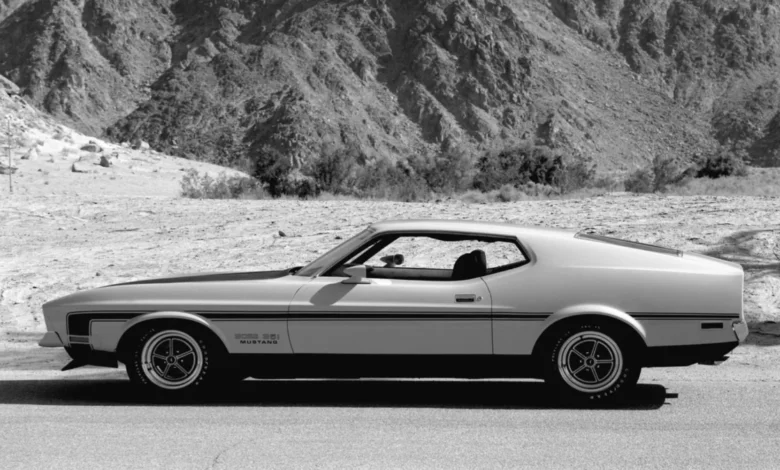
While Shinoda is perhaps most famous for the 1963 "split-window" Corvette, his work on the Mustang "Boss" line defined the aggressive aesthetic of the late-1960s pony car. The 1971 Boss 351 featured a distinctive look that set it apart from the standard SportsRoof models. It boasted a unique "blackout" treatment on the hood, dual racing mirrors, and the iconic "Boss 351" decals along the fenders and trunk lid. The car sat lower and wider than previous iterations, projecting a muscular, planted stance that signaled its performance intentions.
The 1971 Redesign: A Controversial Departure
Despite the mechanical excellence of the Boss 351, the vehicle was wrapped in a body style that proved controversial. The 1971 Mustang underwent a significant growth spurt, becoming more than two inches longer and nearly three inches wider than the 1970 model. This redesign was driven by Bunkie Knudsen’s mandate that the Mustang engine bay be large enough to accommodate the 429-cubic-inch V8 without the expensive hand-modifications required for the 1969-1970 models.
The resulting "flatback" or "large-body" Mustang was met with mixed reviews. Critics and consumers alike noted that the car felt more like a grand tourer than a nimble pony car. Visibility was a major point of contention; the nearly horizontal rear roofline of the SportsRoof models created significant blind spots, making the car difficult to maneuver in tight spaces or heavy traffic. Inside, the dashboard was criticized for its ergonomics, with many drivers finding the auxiliary gauges difficult to read at a glance.
These design choices, combined with the general malaise of the early 1970s economy, took a toll on sales. While the original 1965 Mustang had moved hundreds of thousands of units in its first year, the entire 1971–1973 production run of the "big" Mustangs totaled just over 410,000 units. Within that niche, the Boss 351 was a rarity, with only 1,806 examples produced before Ford discontinued the model.
Chronology of the Boss 351’s Brief Tenure
The timeline of the Boss 351 highlights how quickly the window of opportunity closed for high-performance Mustangs:
- September 1970: Ford introduces the 1971 Mustang lineup, featuring the newly redesigned, larger body style.
- Late 1970: Ford officially announces its withdrawal from factory-supported racing, leaving the "Boss" brand without a direct motorsport connection for the first time.
- November 1970: Production of the Boss 351 begins in earnest, utilizing the specialized Cleveland engine.
- Spring 1971: Automotive journals publish rave reviews of the Boss 351, praising its balance and "giant killer" performance against big-block rivals.
- August 1971: Production of the Boss 351 ends. As the 1972 model year begins, Ford replaces the Boss with the "351 HO" (High Output), which featured lower compression to accommodate new emissions standards.
- 1972 and Beyond: The Mustang continues to grow heavier and less powerful, eventually leading to the radical downsizing of the Mustang II in 1974.
Broader Impact and Implications for the Collector Market
The discontinuation of the Boss 351 marked the end of the high-compression muscle car era at Ford. In the years following its release, the 1971 Boss 351 was often overlooked by collectors who preferred the smaller 1969-1970 bodies. However, in the 21st century, the car has seen a significant resurgence in appreciation.
Automotive historians now view the Boss 351 as perhaps the most "complete" of the vintage Boss Mustangs. While the 302 was a high-strung track car and the 429 was a brute-force drag racer, the 351 provided a sophisticated middle ground. Its rarity—only 1,806 units compared to thousands of Mach 1s—has driven its value upward in the collector market. Well-preserved or correctly restored examples now routinely command six-figure prices at major auctions like Barrett-Jackson and Mecum.
The legacy of the Boss 351 serves as a reminder of a period when engineering excellence was forced to navigate a maze of changing social and legal priorities. It remains a testament to the "Cleveland" engine’s potential and stands as a high-water mark for Ford’s performance division before the industry entered the "Malaise Era" of the mid-1970s. For the 1,806 lucky owners who took delivery in 1971, the Boss 351 wasn’t just a car; it was the final, thunderous roar of a dying breed.