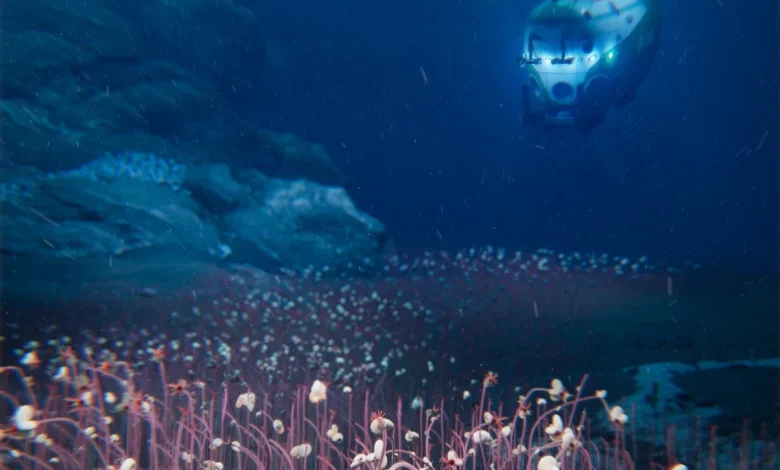
In a discovery that fundamentally challenges our understanding of biological limits, researchers using the Chinese manned submersible Fendouzhe have identified an expansive and vibrant ecosystem of animals nearly six miles below the surface of the Pacific Ocean. The study, published in the journal Nature, documents the deepest chemosynthesis-based community ever observed, populated by thousands of mollusks, tubeworms, and crustaceans. This findings indicate that life at the extreme depths of the Earth’s hadal trenches is far more prevalent and resilient than previous scientific models suggested.
The exploration, conducted by the Institute of Deep-sea Science and Engineering (IDSSE) at the Chinese Academy of Sciences, involved a series of 23 dives into the Mariana Trench and neighboring regions. While the Mariana Trench is famous for being deeper than the height of Mount Everest, the expedition successfully mapped a biological corridor spanning over 1,500 miles, with life concentrated at depths ranging from 3.6 to nearly 6 miles.
A Chronology of Hadal Exploration
The history of exploring the Earth’s deepest trenches is marked by long intervals of mystery followed by rapid technological leaps. The first human descent into the Challenger Deep, the deepest point of the Mariana Trench, occurred in 1960 when Jacques Piccard and Don Walsh piloted the bathyscaphe Trieste to the seafloor. For decades, that brief visit remained an isolated anomaly, leaving scientists with a "desolate" view of the abyss.
It was not until 2012 that filmmaker and explorer James Cameron conducted a solo dive to the bottom, famously describing the environment as an alien, barren landscape. However, the advancement of modern submersible technology—specifically the development of the Fendouzhe—has allowed for longer, more frequent, and more stable scientific observation. The 2024-2025 campaign marks a turning point, moving from mere "exploration" to sustained biological mapping of the hadal zone. By conducting multiple dives, the team was able to observe not just single organisms, but the structural complexity of a functioning, deep-sea society.
The Mechanics of Life Without Sunlight
At these extreme depths, sunlight is entirely absent, precluding any possibility of photosynthesis—the process that sustains the vast majority of life on the planet. The organisms discovered by the Fendouzhe team rely instead on chemosynthesis. This process involves the conversion of inorganic carbon-containing molecules and nutrients into organic matter using the oxidation of hydrogen sulfide or methane as a source of energy.
The research team found that these deep-sea communities are sustained by fluids rich in methane and hydrogen sulfide that seep through active faults in the trench floor. Isotopic analysis of the site suggests that this methane is produced microbially from organic matter deposited in the sediment layers. The tubeworms, some reaching lengths of up to one foot, were observed clustering specifically around snow-like microbial mats, indicating a symbiotic relationship between the larger invertebrates and the methane-consuming bacteria that form the base of the food web.
The sheer density of the life found—described by researchers as a "vibrant oasis"—contrasts sharply with the historical perception of the deep sea as a biological desert. In addition to the tubeworms and bivalves (mollusks), the team documented spiky crustaceans, sea lilies, and various sea cucumbers, all of which appear to have adapted to pressures exceeding 1,000 times that of sea level.
Scientific Implications and Data Analysis
The discovery holds significant weight for the field of marine biology and geochemistry. Lead author Xiatong Peng and co-author Mengran Du emphasize that these communities are not isolated pockets, but rather an interconnected system. The fact that such life was found along a 1,553.4-mile stretch of the trench suggests that the geological conditions required for these communities—specifically the transportation of fluids along deep sediment faults—are likely widespread across the globe’s hadal trenches.

This realization forces a revision of existing carbon-cycling models. Scientists had previously assumed that carbon cycling at these depths was slow and primarily driven by the "marine snow" (detritus falling from the surface). The new data proves that localized, high-energy chemosynthetic production plays a much larger role than previously understood. By identifying that these deep-sea ecosystems can sustain high biomass, the study suggests that the ocean floor acts as a significant, albeit hidden, biological reservoir.
Official Responses and the Ethics of Deep-Sea Mining
The timing of this discovery is critical, as it coincides with intense international debate regarding deep-sea mining. The International Seabed Authority (ISA) is currently under pressure to finalize regulations for the extraction of minerals—such as cobalt, nickel, and manganese—from the seafloor. These minerals are highly sought after for the production of electric vehicle batteries and other renewable energy technologies.
Marine scientists and environmental groups, including organizations like EcoWatch, have issued repeated warnings that the "precautionary principle" must be applied. The discovery of these thriving ecosystems in areas once thought to be nearly lifeless provides powerful evidence for the vulnerability of the deep-sea floor. Environmentalists argue that if such complex life can exist at nearly six miles deep, the risk of irreparable damage from mining operations is far higher than industry proponents have claimed.
"We are only just beginning to understand these environments," noted one marine biologist familiar with the study, who requested anonymity. "To allow industrial-scale excavation in a zone where we are still identifying major biological communities would be to destroy a frontier of science before we have even read the first page."
Broader Impact on Evolutionary Biology
Beyond the immediate environmental policy implications, the study provides new avenues for research into evolutionary biology. The extreme adaptations required for these creatures to survive—not only the crushing pressure but also the reliance on toxic chemical seeps—offer a window into how life might exist on other moons or planets within our solar system.
The "alien" nature of these deep-sea organisms provides a terrestrial analogue for potential life on icy moons like Jupiter’s Europa or Saturn’s Enceladus, where similar subsurface oceans and hydrothermal activity are believed to exist. By studying the metabolic pathways of these deep-sea mollusks and worms, researchers hope to better understand the range of conditions under which life can persist.
Conclusion: A Frontier Still Being Defined
The Fendouzhe expedition has effectively shifted the goalposts for deep-sea research. What was once a realm of shadows and myths is now being documented with high-definition video and geochemical analysis. As the international scientific community digests the implications of the Nature publication, it is clear that the "desolate" abyss described by earlier explorers was a result of our limited technology, not a lack of life.
The discovery serves as a reminder of the Earth’s capacity for life in the most hostile environments. As humans continue to push further into these final frontiers, the responsibility to protect these ecosystems grows in tandem with our knowledge. The "vibrant oasis" of the Mariana Trench is not just a scientific curiosity; it is a vital component of the planet’s biosphere, one that remains largely mysterious, fragile, and essential to our understanding of life’s resilience in the face of extreme pressure and absolute darkness.
Future missions are already being planned to further explore the Kuril-Kamchatka and western Aleutian Trenches to see if the density of life found in the Mariana is the rule or the exception. For now, the scientific community remains focused on analyzing the thousands of images and data points collected by the Fendouzhe, each one a testament to the fact that the deepest parts of our world are far more alive than we ever dared to imagine.