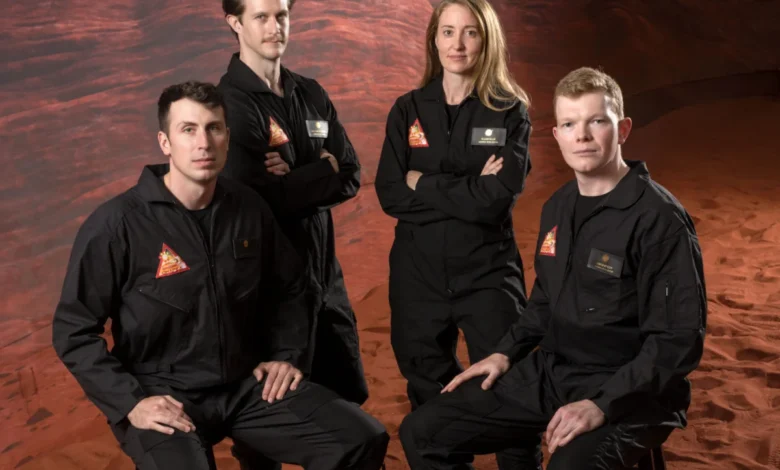
After enduring more than a year of strict isolation, simulated communication delays, and rigorous daily routines designed to mimic life on the Red Planet, four dedicated volunteers are preparing to step back into the outside world. On Saturday, October 31, Ross Elder, Ellen Ellis, James Spicer, and Matthew Montgomery will finally emerge from the Crew Health and Performance Exploration Analog (CHAPEA) facility at NASA’s Johnson Space Center in Houston, Texas, concluding a grueling 378-day journey that began on October 19, 2025.
The hatch-opening event marks the completion of the second simulated Mars mission under the CHAPEA program, a critical initiative engineered to pave the way for real human exploration of the Moon and Mars. Throughout their year-long tenure, the crew lived and worked inside a specialized 1,700-square-foot habitat constructed entirely using 3D-printing technology. This enclosed environment served as their entire universe, forcing them to confront the psychological, physiological, and logistical hurdles that future astronauts will inevitably face when humanity makes the monumental leap to deep space exploration.
To mark the milestone, NASA has organized a comprehensive live broadcast of the departure ceremony, scheduled to begin at 3 p.m. EDT. The event will be streamed globally across NASA Johnson’s official YouTube channel and various social media platforms. Vanessa Wyche, director of the Johnson Space Center, alongside NASA astronaut Jack Hathaway, will deliver official welcoming remarks to honor the crew’s dedication and sacrifice. Following the formal proceedings, the four crew members will address the public and media, sharing initial reflections on what it feels like to breathe fresh air and see the open sky after more than a year underground.
Life Inside the Martian Dune Alpha
The CHAPEA facility, officially designated as Mars Dune Alpha, is an engineering marvel designed to simulate the harsh realities of a Martian outpost as closely as possible on Earth. Within its 1,700 square feet, the four-person crew engaged in a multitude of activities mirroring an actual planetary surface mission. Their daily schedules were meticulously planned to test human endurance against the backdrop of systemic stressors inherent to deep space exploration.
Among their core responsibilities were simulated spacewalks—referred to as "Marswalks"—which required the crew to don pressurized suits and navigate a specialized outdoor-in-hangar sandbox area designed to mimic the Martian terrain. Additionally, the volunteers maintained the structural integrity of their 3D-printed habitat, managed complex life-support systems, and cultivated crops to study sustainable food production in a closed-loop system.
However, the physical labor was only part of the challenge. The isolation experiment was purposefully laced with compounding psychological stressors. Most notably, the crew experienced realistic communication delays of up to 22 minutes each way when interacting with mission control. This latency, which naturally occurs due to the vast distance between Earth and Mars, meant the crew could not rely on real-time assistance or casual conversations with loved ones, forcing them to develop high levels of autonomy, self-reliance, and team cohesion. Furthermore, the habitat imposed strict resource limitations regarding water, electricity, and consumables, compelling the volunteers to carefully ration every resource just as real interplanetary pioneers must do.
The Chronology of CHAPEA Mission 2
The journey of the second CHAPEA crew represents the culmination of years of meticulous planning, astronaut selection, and psychological vetting by the United States space agency.
- Selection and Training: Ross Elder, Ellen Ellis, James Spicer, and Matthew Montgomery were chosen from a highly competitive pool of applicants who met stringent NASA criteria, including advanced degrees in STEM fields, professional experience in aviation, engineering, or scientific research, and exceptional psychological resilience. Prior to entering the habitat, the crew underwent months of intensive training in geology, robotic operations, maintenance, media relations, and emergency medical response.
- Mission Initialization (October 19, 2025): The habitat hatch officially closed behind the four volunteers, initiating the 378-day countdown. From this moment onward, physical contact with the outside world ceased, and the simulated distance from Earth began to dictate their daily existence.
- Mid-Mission Operations (Spring and Summer 2026): Throughout the long months inside Mars Dune Alpha, the crew managed various simulated anomalies, ranging from equipment malfunctions to mock power grid failures. They also participated in ongoing psychological assessments, nutritional studies, and physiological monitoring to track how prolonged isolation affected their sleep patterns, cognitive performance, and group dynamics.
- The Final Stretch (October 2025): As the mission approached its conclusion, the focus shifted toward data consolidation, final crop harvests, and preparing the habitat’s systems for post-mission analysis.
- The Hatch Opening (October 31, 2025): The crew will finally unlock the hatch, marking the official end of Mission 2 and beginning a new chapter of data evaluation for NASA researchers.
Data Collection and Human Spaceflight Implications
While the public often views analog missions through the lens of endurance and adventure, the primary objective of CHAPEA is fundamentally scientific. The comprehensive health and performance data harvested from the four volunteers over the past 378 days will serve as a vital bedrock for NASA’s Artemis program and future crewed missions to Mars.
As humanity looks toward establishing a sustainable presence on the lunar surface through Artemis base camps, flight surgeons, psychologists, and mission architects face unprecedented challenges. The data gathered during the CHAPEA simulation will be instrumental in several key operational areas:
- Nutritional and Food System Optimization: By studying how the crew managed and utilized crops grown within the habitat, researchers can refine food system architectures to ensure deep-space travelers receive adequate nutrition without overburdening cargo capacities.
- Crew Time and Workflow Efficiency: Analyzing how the volunteers structured their workdays under isolation and fatigue will help mission planners design more effective daily schedules, balancing productivity with essential rest periods to prevent burnout.
- Deep Space Network Bandwidth Management: The communication delays experienced by the crew provided valuable insights into how autonomous operations can be streamlined, optimizing the use of NASA’s Deep Space Network for telemetry and personal communications.
- Behavioral Health and Medical Support: Perhaps most importantly, psychologists and flight surgeons will review the biometric and behavioral data to strengthen medical care protocols. Understanding the long-term psychological impacts of isolation helps agencies develop better screening tools, in-flight support mechanisms, and post-mission readjustment programs.
Media Participation and Official Protocols
NASA has established strict protocols for media outlets wishing to cover the historic exit ceremony in person or engage with the crew in the days following their release. Journalists interested in attending the live event at the Johnson Space Center on Saturday, October 31, or those requesting virtual interviews with Ross Elder, Ellen Ellis, James Spicer, and Matthew Montgomery, are required to coordinate through the NASA Johnson newsroom. Credentials and formal requests must be submitted to the designated email address no later than 2 p.m. EDT on Friday, October 30.
Accredited media representatives attending the event in person will be stationed outside the hangar housing the CHAPEA facility. They will have the unique opportunity to capture the exact moment the four volunteers step outside the building, marking their literal and figurative return to Earth after more than a year of confinement. Furthermore, NASA subject matter experts will be available on-site immediately following the ceremony to answer technical and scientific questions regarding the analog mission and its broader implications for space exploration.
Broader Impact on the Future of Interplanetary Travel
The successful conclusion of the second CHAPEA mission represents a major stepping stone in humanity’s quest to become a multi-planetary species. As space agencies and private commercial aerospace companies alike set their sights on deep-space destinations, the lessons learned in Houston will reverberate across the global scientific community.
Simulated environments like Mars Dune Alpha provide a low-risk, high-fidelity laboratory where mission failures carry no catastrophic consequences, allowing researchers to test, fail, and refine protocols before human lives are placed on the line millions of miles away from Earth. The psychological resilience demonstrated by Elder, Ellis, Spicer, and Montgomery underscores the extraordinary capability of the human spirit to adapt to alien, restrictive environments.
As NASA continues to digest the influx of biomedical and operational data, the agency moves one step closer to making crewed missions to Mars a reality. The sacrifices made by these four volunteers inside a 3D-printed habitat in Texas will ultimately help guide the footsteps of the first human beings to walk upon the red dust of Mars, ensuring they are better prepared, better supported, and better equipped to survive the ultimate frontier.
Related posts: